



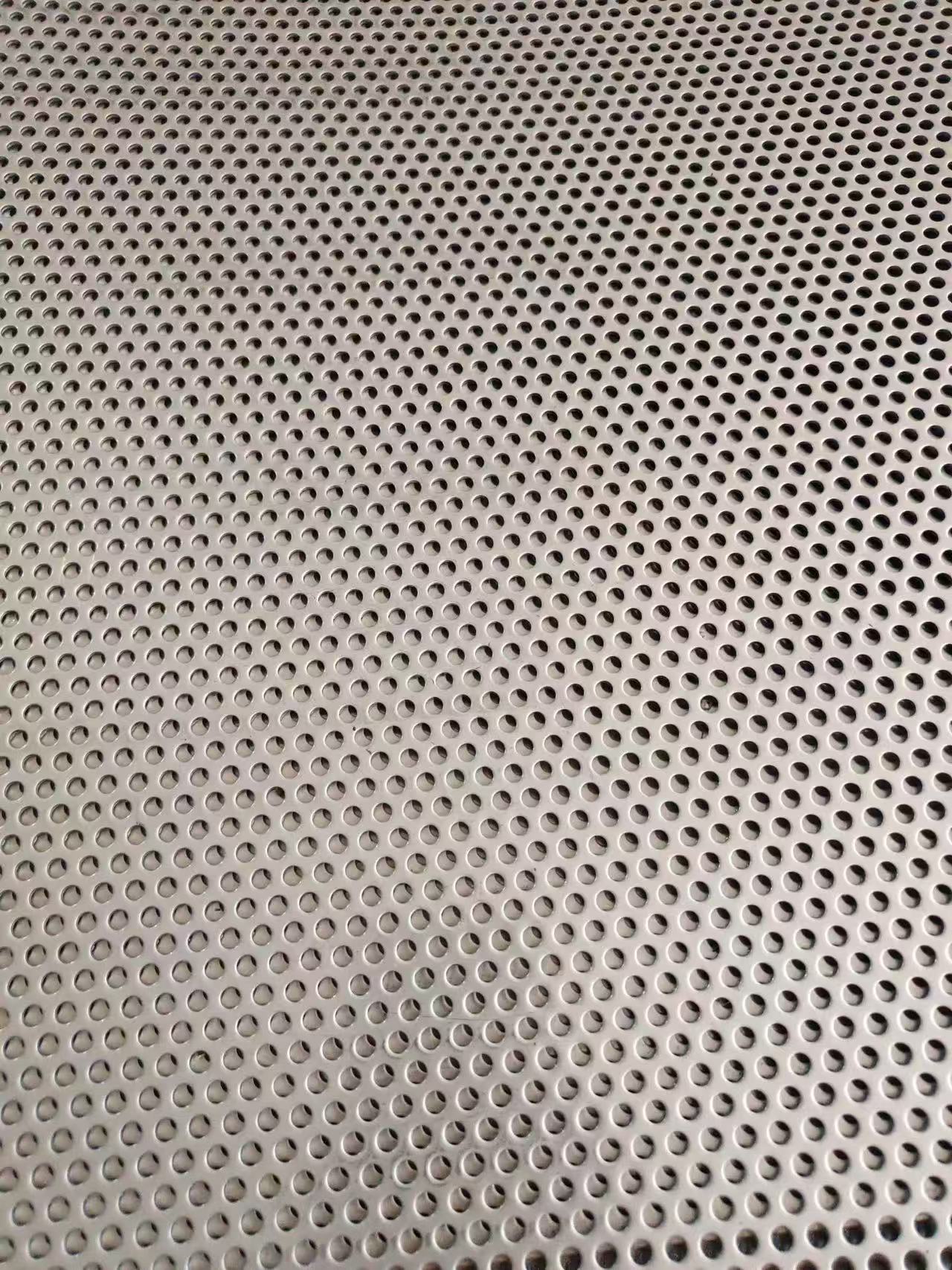
Supermarket Bulkhead Galvanized Perforated Metal Installation Guide: Deep Dive into Threaded Rod Suspension
Supermarket Bulkhead Galvanized Perforated Metal Installation Guide: Deep Dive into Threaded Rod Suspension
1. Why Supermarket Bulkheads Increasingly Favor Galvanized Perforated Metal
In commercial retail space design, the bulkhead is a critical suspended element above shelving that carries brand identity and divides zones. In recent years, galvanized perforated metal bulkheads have gradually replaced traditional wood veneer and aluminum composite panels, becoming the mainstream choice for supermarket renovations.
Structural Performance. After bending, the folded edges of galvanized perforated metal form reinforcing ribs, significantly improving rigidity. Industry practice shows that 1.0–1.2 mm thick galvanized perforated sheet maintains a flat surface under 400–600 mm keel spacing without sagging in the middle.
High Functional Integration. The hole patterns of perforated metal (round, square, hexagonal, etc.) naturally provide ventilation and acoustic regulation. Research published by the Japan Society of Powder and Powder Metallurgy indicates that porous sintered aluminum-based materials, due to their three-dimensional structure, exhibit smoother absorption curves over a wider frequency range than conventional perforated metal sheets. When acoustic fleece is added to the back of a bulkhead, ambient noise from customer traffic and refrigeration equipment can be effectively reduced.
Durability and Maintenance Cost. The hot-dip galvanized layer protects the steel substrate through zinc's sacrificial anode mechanism. In the humid, dusty, high-traffic supermarket environment, galvanized perforated metal bulkheads can last over 10 years.
Related Reading: Decorative Perforated Metal Product Page | Jintong Instagram
2. Core Technical Standards for Bulkhead Installation
Before diving into installation methods, it is essential to understand the international standards for perforated metal products, as they directly affect material selection and project quality.
ASTM Standards. ASTM E674-12(2021) specifies the standard sizes for round-hole industrial perforated plates, covering hole diameters from 5 inches (125 mm) down to 0.020 inches (500 μm). It also lists standard hole sizes and plate thicknesses for various grades of service. For detailed specifications, visit the ASTM official website.
ISO Standards. ISO 10630:1994 specifies technical requirements and test methods for perforated metal plates for industrial screening, applicable to low-carbon steel perforated plates with round hole nominal sizes from 1 mm to 125 mm, square holes from 4 mm to 125 mm, and maximum plate thickness of 12.5 mm. ISO 7806:1983 defines the designation of holes in perforated plates, including hole shape, size, arrangement, pitch, and orientation relative to the plate edge.
DIN Standards. German DIN 24041:2022-06 provides detailed dimensional tolerances for perforated plates, covering round holes (staggered Rv, diagonal staggered Rd, straight Rg), square holes (staggered Qv, diagonal staggered Qd, straight Qg), slotted holes (Lv, Lg, Lge), and hexagonal holes (SKv). It also specifies perpendicularity tolerances, camber limits, and flatness tolerances as technical delivery conditions. European projects should pay close attention to this standard.
Installation Tolerance Reference. The Los Angeles County Public Works construction specification requires that perforated metal panels be installed with a tolerance not exceeding 1/4 inch (approx. 6.4 mm) from the correct position, and not exceeding 1/8 inch (approx. 3.2 mm) from plumb, level, and alignment lines. This can serve as a reference benchmark for supermarket bulkhead installation.
International Perforators Association (IPA) publishes the Buyers Handbook of Perforated Metals, the authoritative reference for perforated metal design and procurement, covering hole selection, open area calculation, and material selection.
3. Option 1: Threaded Rod Suspension (Recommended)
Threaded rod suspension is the preferred method for long bulkheads with LED strips and illuminated letters, and it is the most stable approach for supermarket renovation projects.
3.1 Layout and Positioning
Use a laser level to mark the bulkhead elevation line and centerline on the ceiling, and mark the hanger rod positions on the surrounding walls. Hanger rod spacing should be controlled at 800–1000 mm. At corners and illuminated letter positions, spacing must be tightened to 600 mm. Illuminated letters are concentrated loads, and hanger rods at these positions must be additionally reinforced. This point is often overlooked in practice, leading to localized sagging after the illuminated letters are installed.
3.2 Top Hanger Rod Fixing
Drill expansion bolts or chemical anchors into the floor slab and suspend 8 mm or larger galvanized threaded rods. Adjusting nuts are installed at the lower end of the rods for precise leveling. Note that when the rod length exceeds 1.5 meters, lateral bracing must be added to prevent swaying. Lateral bracing can be made of angle steel or galvanized square tube diagonally tensioned, with one end fixed to the middle of the rod and the other end fixed to the surrounding structure.
3.3 Galvanized Square Tube Frame Assembly
Main square tubes are recommended as 40×40 or 50×30 galvanized square tubes. Secondary keels use 40×20 square tubes with spacing of 400–600 mm, matching the width of the perforated panels. All welded joints on the frame must be ground and painted with anti-rust paint. After connecting the frame to the hanger rods, level it with a horizontal error of ≤3 mm. Armstrong Ceilings' MetalWorks installation guidelines recommend hanger rod spacing within 2 feet (approx. 600 mm) of the ends and 4 feet (approx. 1200 mm) in the middle section, which can serve as an engineering reference.
Key Detail: During frame assembly, pre-drill wire passage holes for LED strips and illuminated letters. It is best to ask the perforated metal manufacturer to pre-fabricate these holes when ordering to avoid damaging the galvanized layer on site.
3.4 Fixing the Perforated Panels
The perforated panels come with folded edges or pre-fabricated corner brackets on the back. Use stainless steel self-tapping screws or rivets to fix them to the square tube frame. Do not drive screws into the holes; they should be placed in the solid areas. Leave 1–2 mm expansion gaps between panels to accommodate thermal expansion and contraction of the galvanized sheet.
Two fixing appearance options:
- ✅ Back corner bracket fixing – No visible screws on the front, high aesthetic quality, first choice for supermarket sales floors.
- ⚠️ Front countersunk screws – Lower cost, but exposed screws affect visual appearance; generally not recommended for sales floor fronts.
3.5 Lighting, Letters, and Edge Trim
After installing the built-in LED strips and illuminated letters, use galvanized edge trim to finish the joints and side edges, then peel off the protective film. Note that LED strip wires must be run through corrugated conduits fixed inside the frame; they must not be left suspended. Also avoid the sharp hole edges of the perforated panels to prevent insulation damage and safety hazards.
Learn more installation cases: Official Website Case Library
4. Option 2: Light Steel Keel Simple Suspension
The light steel keel option is suitable for short bulkhead sections, lightweight panels, and no heavy illuminated letters. The method involves suspending the main light steel keel with threaded rods, using secondary keels to support the folded edges of the perforated panels, and fixing with screws.
Applicable Boundaries: This option is not suitable for long bulkheads (over 6 meters) or bulkheads with large illuminated letters. Light steel keels have limited load-bearing capacity and are prone to deflection under concentrated loads and long spans. If the bulkhead length exceeds 8 meters and includes illuminated letters, Option 1 should be preferred.
Cost Comparison: The material cost and labor hours for the light steel keel option are approximately 60%–70% of the threaded rod option, but its applicable scope is significantly limited. It is recommended to choose based on the actual length, load conditions, and aesthetic requirements of the bulkhead.
5. Five Key Considerations for Galvanized Perforated Metal Bulkheads
5.1 Preventing Galvanic Corrosion
Rubber gaskets or neoprene isolation pads must be added between the galvanized sheet and the steel keel to prevent direct metal-to-metal contact that can cause galvanic corrosion.
The American Galvanizers Association (AGA) points out that a bimetallic couple requires four conditions: an anode (less noble metal), a cathode (more noble metal), an electrolyte (such as rainwater or condensation), and a current path (direct contact between the two metals). In practice, the anode and cathode cannot be eliminated; what we can do is break the current path by inserting a non-conductive material (such as rubber, plastic, or ceramic gaskets) between the two metals. AGA also emphasizes that in marine environments or areas with de-icing salts, the conductivity of the electrolyte increases significantly, and the risk of galvanic corrosion rises markedly. For more details, visit the AGA knowledge base.
All welded joints must be painted with anti-rust paint and repaired with matching powder coating. Welding heat destroys the galvanized layer, and if not repaired promptly, these locations become starting points for rust.
5.2 Material Selection
Supermarket bulkheads commonly use 1.0–1.2 mm galvanized perforated sheet with folded edges around the perimeter to enhance rigidity. Sheets that are too thin (below 0.8 mm) will sag in the middle and have an uneven surface, showing obvious waviness from the side. If the bulkhead width exceeds 600 mm, it is recommended to increase the sheet thickness to 1.2 mm or add internal reinforcing ribs.
Flatness tolerances for perforated plates can refer to DIN 24041, which specifies flatness tolerance limits for machine-straightened sheets.
5.3 Wiring Regulations
LED strip wires must be run through corrugated conduits and fixed inside the frame; they must not be suspended. Wires must avoid the hole edges of the perforated panels—burrs exist on punched hole edges, and long-term vibration may damage the insulation layer. It is recommended to install rubber grommets at wire passage holes.
5.4 Safety Verification
Supermarkets are densely populated places, and the bulkhead frame and hanger rods must be verified for load-bearing capacity. The verification includes: dead load (perforated panels, frame, LED strips, illuminated letters), live load (maintenance load considered at 0.5 kN/m²), and wind load (if air conditioning outlets face the bulkhead). Illuminated letters are concentrated loads, and the hanger rod spacing at their positions must be tightened to 600 mm, with double rods used if necessary.
5.5 Panel Layout and Alignment
Aligned perforation patterns and straight hole lines are the foundation of the bulkhead's visual effect. Before ordering, be sure to confirm the following parameters with the perforated metal manufacturer: folding direction and angle, corner bracket positions and spacing, and pre-drilled wire passage hole positions and diameters. It is recommended to provide a CAD layout drawing of the bulkhead, marking the size, hole pattern, and folding direction of each panel to avoid misalignment during installation.
Product Inquiry: Contact Jintong Team
6. Case Study: From Frequent Repairs to Five Years of Zero Failures
Background. A supermarket chain in South China launched a store upgrade in 2021, involving bulkhead renovations in 12 stores. Previously, the brand used wood veneer bulkheads, which after two years of operation suffered from moisture deformation, joint cracking, and LED strip failures, with annual repair costs exceeding RMB 80,000.
Challenge. The renovation window was tight (only 72 hours of closure per store). The bulkheads needed to carry brand illuminated letters and LED strips, and the supermarket environment had high humidity, requiring strict corrosion protection.
Solution. The Jintong team provided a custom galvanized perforated metal bulkhead solution for the project. The material selected was 1.2 mm hot-dip galvanized perforated sheet with Φ5 mm round holes, 8 mm pitch, and 60° staggered arrangement, with 20 mm folded edges around the perimeter for reinforcement. The frame used 40×40 galvanized square tubes with 900 mm threaded rod spacing, tightened to 600 mm at illuminated letter positions. EPDM isolation pads were installed at all contact surfaces between panels and keels, effectively breaking the current path required for galvanic corrosion. Wire passage holes and corner bracket mounting holes were pre-fabricated at the factory, greatly improving on-site installation efficiency.
Result. All 12 stores were renovated within 6 weeks. The installation time per store was reduced from an expected 16 hours to 10 hours. More than 3 years after completion, no panel deformation, rust, or LED strip failures have occurred in any store. The brand has incorporated galvanized perforated metal bulkheads into its standard design for future new stores.
Want to know which option suits your project? WhatsApp Inquiry | Connect with Andy Liu on LinkedIn
7. Simple Construction Sequence
Layout → Install expansion bolts and threaded rods on ceiling → Assemble galvanized square tube frame and level → Internal wiring and LED strip fixing → Hoist perforated panels → Install illuminated letters → Edge trim and protective film removal
8. Quotation Checklist
When requesting a quote from a perforated metal manufacturer, provide the following information:
- Sheet thickness: 1.0 mm / 1.2 mm / 1.5 mm
- Hole diameter and pitch: e.g., Φ5 mm / 8 mm
- Arrangement: straight or staggered
- Folding direction and dimensions: e.g., 20 mm folded edges on all sides
- Corner bracket positions and spacing
- Pre-drilled wire passage hole positions and diameters
- Surface treatment: hot-dip galvanized / powder coated / PVDF coated
- Quantity and size list
9. FAQ
Q1: How long does a galvanized perforated metal bulkhead last?
In a normal supermarket operating environment, a bulkhead made of hot-dip galvanized perforated sheet (zinc coating ≥60 μm) typically lasts over 10 years. Key factors include ambient humidity, weld repair quality, and whether galvanic isolation measures are in place.
Q2: How to choose between threaded rod suspension and light steel keel suspension?
Choose threaded rod suspension when the bulkhead length exceeds 6 meters, includes illuminated letters, or requires high aesthetics (no visible screws on the front). Consider the light steel keel option for short bulkheads (≤3 meters), no heavy illuminated letters, and limited budget.
Q3: How much expansion gap should be left between perforated panels?
1–2 mm is recommended. Thermal expansion and contraction of galvanized sheet under temperature variations cannot be ignored; no gap will cause panel bulging.
Q4: How to repair rust protection after welding?
After grinding the welded area, apply two coats of epoxy zinc-rich primer, then topcoat. If appearance requirements are high, use a powder repair agent matching the panel color.
Q5: What if the perforation patterns are misaligned?
This is a layout issue and should be resolved before ordering. Provide the manufacturer with a layout drawing marked with hole patterns and confirm the starting position of the hole pattern on each panel to ensure straight hole lines after installation.
Q6: Does the bulkhead frame need fire protection treatment?
Supermarkets are commercial buildings, and the fire rating of the bulkhead frame and panels must comply with local building fire codes. Steel frames are non-combustible, but fire protection for LED strips and wiring must meet electrical code requirements.
Q7: Can I spray paint directly on galvanized perforated sheet?
Yes, but surface preparation is required. Galvanized sheet has a smooth surface, and direct painting has poor adhesion. It is recommended to clean the surface with alcohol or thinner, sand with 240–320 grit sandpaper, apply a metal primer, and then spray the topcoat.
10. Authoritative References & Further Reading
- ASTM E674-12(2021) – Standard Specification for Perforated-Plate Sieves for Testing Purposes: ASTM Official Website
- ISO 10630:1994 – Industrial perforated metal plates – Technical requirements and test methods: ISO Official Website
- DIN 24041:2022-06 – Perforated plates – Dimensions and tolerances: DIN Official Website
- American Galvanizers Association – Galvanic Corrosion Prevention Guide: galvanizeit.org
- Armstrong Ceilings – MetalWorks Concealed Installation Guidelines: Armstrong Official Website
- Zahner – Architectural Perforated Metal Facade Design Guide (including bimetallic corrosion protection): Zahner Official Website
- USG Paraline Plus – Linear Metal Ceiling System Design Guide (including perforated acoustic performance data): USG Official Website
Contact Information
📞 Tel/WhatsApp: +86 180 2733 7739
📧 Email: jtsw58@gmail.com
🌐 Website: perforatedmetalpanel.com
📸 Instagram: instagram.com/jintongperforatedmetal
💬 WhatsApp: api.whatsapp.com/send?phone=8618027337739
🔗 LinkedIn: Andy Liu
📘 Facebook: facebook.com/me
▶️ YouTube: Jintong Channel
Have a bulkhead project that needs a quote? Please provide bulkhead dimensions, hole pattern, and quantity list. Our engineers will reply with a solution and quotation within 24 hours.
Keyword Groups
perforated metal sheet, perforated plate, perforated panel, galvanized perforated sheet, decorative perforated metal, architectural perforated panel, supermarket bulkhead, ceiling bulkhead, bulkhead panel, perforated metal ceiling, perforated facade panel, custom perforated metal, stainless steel perforated sheet, aluminum perforated panel, perforated metal supplier, perforated metal manufacturer, perforated metal installation, perforated ceiling panel, metal ceiling bulkhead, perforated metal screen, punched metal sheet, laser cut perforated panel, perforated metal price, perforated metal sheet China, galvanized steel perforated plate, perforated metal panel factory, perforated metal ceiling system, suspended metal ceiling, metal bulkhead panel, perforated metal cladding, perforated acoustic panel, hexagonal perforated sheet, round hole perforated plate, square hole perforated sheet, louver perforated panel, fish eye perforated sheet, anti-slip perforated plate, crocodile mouth perforated plate, woven wire mesh, architectural wire mesh
Interactive Hook: What installation challenges have you encountered with supermarket bulkheads? Sagging, panel corrosion, or misaligned hole patterns? Leave a comment below, and we will provide a free technical solution and material selection advice. The first 5 commenters will receive a free layout design service from the Jintong team.