

Exterior Wall Perforated Decorative Panels: Galvanized Steel vs. Aluminum vs. Stainless Steel — A Complete Comparison Guide
Exterior Wall Perforated Decorative Panels: Galvanized Steel vs. Aluminum vs. Stainless Steel — A Complete Comparison Guide
One-Sentence Summary: Galvanized steel is cost-effective but vulnerable to cut-edge corrosion; aluminum is the lightest and, with PVDF coating, suits most curtain wall applications; stainless steel offers the highest corrosion resistance, making it the first choice for coastal projects — at the highest price point.
1. Overview: Why Material Selection Determines Facade Longevity
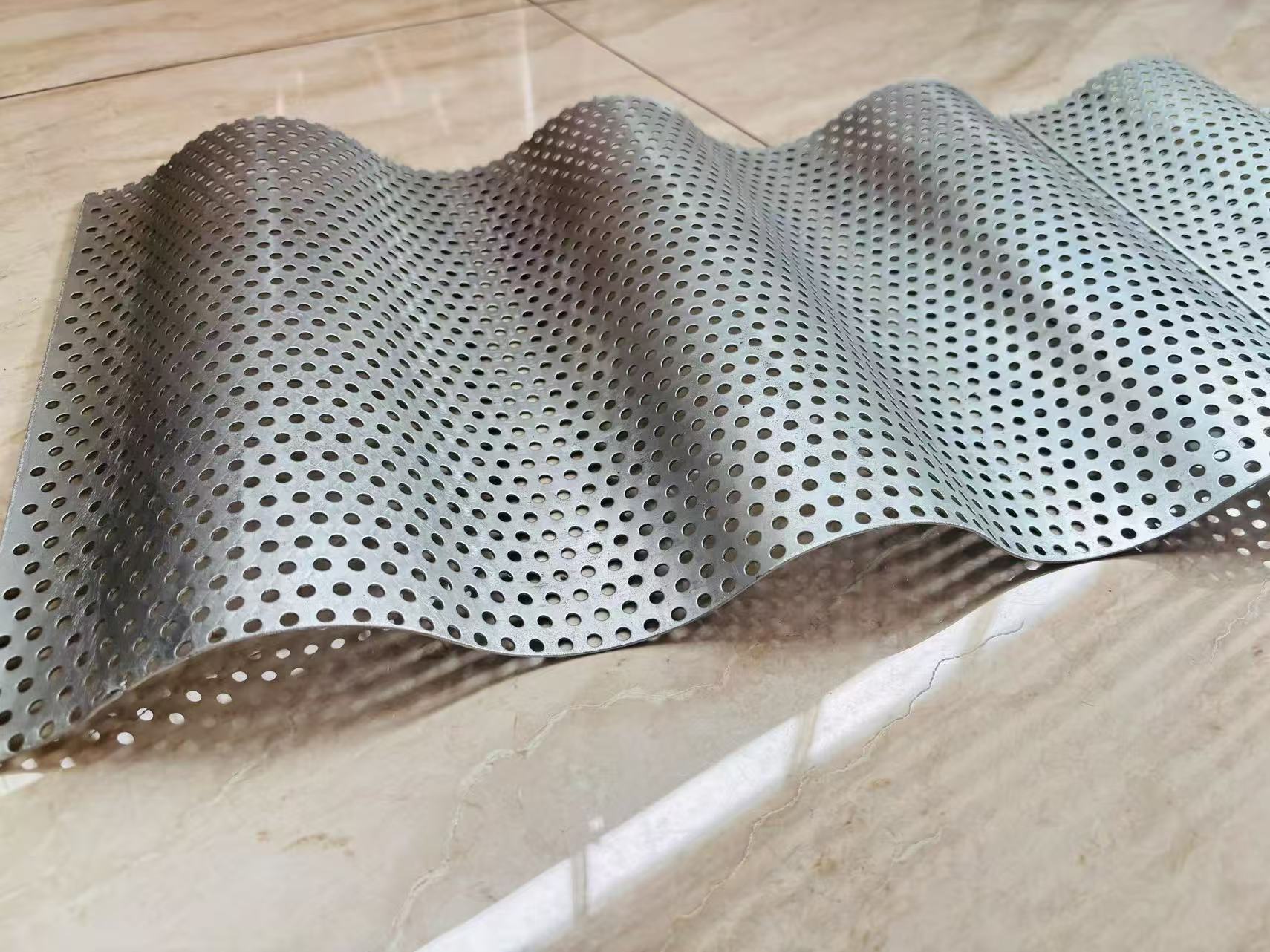
Perforated metal facade panels have evolved far beyond their industrial origins as filter screens. Today, they function as high-performance architectural envelopes that simultaneously deliver airflow, light transmission, visual screening, acoustic control, solar shading, and decorative effects. For architects, developers, and procurement teams, the critical decision is not whether to use perforated metal, but which metal to specify for a given environment.
The three dominant materials for exterior perforated facade panels — galvanized steel, aluminum alloy, and stainless steel — differ dramatically in weight, corrosion behavior, coating compatibility, forming characteristics, and total cost of ownership. Choosing incorrectly can mean premature rust, panel deformation, or excessive structural load. This guide provides a scientifically grounded, side-by-side comparison to support specification decisions.
Key Selection Drivers. Before evaluating materials, define three performance inputs: structural requirement (load, span, deflection), environmental exposure (corrosion, UV, chemicals), and functional requirement (airflow, screening, acoustics). Material, thickness, and hole pattern decisions should always be derived from these inputs rather than appearance or default specification.
For decorative architectural applications, the decorative perforated metal panel product family covers a range of materials and finishes suitable for both interior and exterior use.
2. Material Performance Comparison at a Glance
| Feature | Galvanized Steel (SGCC) | Aluminum (3003/5052) | Stainless Steel (304/316L) |
|---|---|---|---|
| Weight | Heavy | Extremely Light | Heavy |
| Corrosion Resistance | Moderate (intact coating) | Excellent | Superior (316L for coastal) |
| Fire Rating | Non-combustible | Non-combustible | Non-combustible |
| Formability | Moderate | Excellent | Difficult (high springback) |
| Coating Compatibility | Powder/PVDF (with pretreatment) | PVDF/Anodizing/Powder | Natural/Coated |
| Typical Facade Use | Budget/low-rise | Mainstream curtain walls | Coastal/high-end |
| Relative Cost | Lowest | Medium | Highest |
| Maintenance | High | Low | Very Low |
Data compiled from industry sources
3. Galvanized Steel Perforated Sheet (SGCC Hot-Dip Galvanized)
3.1 Advantages
Lowest material cost. Galvanized steel perforated sheet offers significant raw material cost advantages over aluminum and stainless steel, making it attractive for budget-sensitive projects.
High substrate strength. The steel base provides superior impact resistance and load-bearing capacity compared to aluminum of equivalent thickness. Punching and forming are straightforward with standard CNC equipment.
Basic corrosion protection when coating is intact. The zinc layer acts as a sacrificial anode, protecting the steel substrate through electrochemical mechanisms. In its complete state, the zinc coating provides baseline rust protection, and the surface can be powder coated or baked for exterior color.
Research insight: Cathodic self-healing at cut edges is a well-documented phenomenon in galvanized steel. When the zinc coating is damaged, zinc corrosion products precipitate on the exposed steel surface, inhibiting oxygen reduction and slowing further corrosion. However, this self-healing capacity is limited — a small area of exposed zinc cannot indefinitely protect a comparatively large steel area.
3.2 Limitations
Cut-edge corrosion — the critical weakness. The most serious limitation of galvanized perforated sheet is that every punched hole creates an exposed steel edge where the zinc coating has been severed. The corrosion rate ratio of steel to zinc coating is approximately 100:1, meaning once the zinc is consumed at the cut edge, the underlying steel corrodes rapidly. In coastal or high-humidity environments, sea breeze accelerates zinc oxidation and flaking, leading to localized rust spots.
High self-weight. Galvanized steel is approximately 2.5 times heavier than aluminum of equivalent thickness. For exterior facades, this increases structural steel framework requirements, raising both material and installation costs.
Limited service life in harsh environments. Standard zinc coating (≥50 μm) achieves an outdoor lifespan of 5–10 years. Even with baked paint, once the coating is breached, the underlying steel begins to rust. Post-galvanizing (punch first, then galvanize) combined with regular maintenance can extend service life beyond 10 years in most settings, but coastal and industrial environments remain challenging.
Recommended applications: Budget-limited projects, dry inland areas, low-rise storefronts, temporary structures, and perimeter wall decoration. Not recommended for high-rise curtain walls or coastal projects.
For suitable product options, explore the galvanized perforated metal sheet range, which includes hot-dip galvanized options with coating thicknesses from 60 to 120 g/m².
4. Perforated Aluminum Panel (3003/5052 Alloy with PVDF Coating)
4.1 Advantages
Lightest weight. Aluminum's low density significantly reduces structural load on the building frame. This is a decisive advantage for high-rise curtain wall applications, where every kilogram of facade weight translates into structural steel savings. Aluminum is the standard material for facade and sunscreen applications because of its light weight, corrosion resistance, and suitability for anodizing and powder coating in custom colors.
Exceptional formability. Aluminum can be easily bent, curved, and formed into complex geometric shapes, making it the most versatile material for architectural facades. This enables complex shaped panels, gradient perforation patterns, and custom designs that would be difficult or impossible with steel.
Excellent weather resistance with PVDF coating. The aluminum substrate naturally forms a protective aluminum oxide film. When combined with fluorocarbon (PVDF) coating, the panel achieves 20+ years of weather resistance without chalking or fading. Research published by the Japan Society for Finishings Technology documented that thermoplastic fluorocarbon enamel-coated aluminum panels underwent 5,000 hours of salt spray testing and 10,000 hours of accelerated weathering testing, maintaining quality characteristics equal to Japanese products in overseas supply programs (Malaysia, Singapore, Taiwan).
Localized damage tolerance. Even if the coating is scratched locally, the aluminum substrate does not rust extensively like steel. It only develops minor oxidation whitening, which is far less visually intrusive than the red rust spread on steel.
Color versatility. PVDF coating offers a wide color range with a premium finish quality, making aluminum the mainstream material for modern curtain walls.
4.2 Limitations
Higher cost than galvanized steel. Aluminum raw material and coating costs are significantly higher than galvanized steel.
Softer material — deformation risk. Aluminum is softer than steel. Large panels with high open-area ratios are prone to slight deformation. Back-side reinforcing ribs or folded edges are necessary to maintain flatness. Research on double-skin perforated-sheet facades found that folding perforated sheet edges is recommended over the use of support frames, and that steel sheets outperformed thinner aluminum sheets in deformation resistance.
Standard powder coating has limited outdoor life. Not all coatings are equal. Standard polyester powder coating does not perform as well as PVDF in exterior applications. PVDF or fluorocarbon coating should be specified for all exterior facades.
Recommended applications: The vast majority of formal exterior curtain walls, high-rise buildings, public architecture, and complex facades. Suitable for coastal areas (though stainless steel is preferred in areas with extremely heavy salt spray).
For custom perforation patterns and PVDF-coated aluminum panels, visit perforatedmetalpanel.com.
5. Stainless Steel Perforated Sheet (304 / 316L)
5.1 Advantages
Ultimate corrosion resistance. Stainless steel is the premier choice for the most demanding environments. Type 304 is suitable for inland applications, while Type 316L — containing molybdenum for enhanced chloride resistance — is specified for coastal and chemical exposure. Electrochemical studies comparing AISI 304 and 316L in Caribbean seawater showed that 316L reached half the negative potential value of 304, indicating significantly better pitting corrosion resistance.
Aesthetic versatility. Stainless steel offers a strong metallic character in natural brushed or mirror finishes, and can also be painted. The substrate itself does not rust, so even if the coating is damaged, there is no rust risk.
High hardness, impact resistance, and wear resistance. Stainless steel is highly durable, easy to clean, and requires minimal maintenance over its service life.
5.2 Limitations
Highest cost among the three. Stainless steel is the most expensive option for perforated facade panels.
Difficult forming. The material is hard with high springback, making bending and complex shaping more difficult and costly than aluminum. Welded joints require grinding and passivation treatment.
Aesthetic concerns with natural finish. Natural stainless steel can show fingerprints and rain streaks outdoors. Large-area natural-finish facades may appear monotonous.
Recommended applications: Coastal and marine projects, high-corrosion environments, high-end storefronts, and feature decorations. Not recommended for large-area standard curtain walls due to cost.
Explore the stainless steel perforated sheet product range for coastal-grade options.
6. International Standards Governing Perforated Metal Quality
Material selection alone does not guarantee project success. International standards ensure that perforated panels meet dimensional, structural, and testing requirements.
ASTM Standards. ASTM E674-12(2021) covers round opening perforated plates for general industrial uses, with openings from 5 inches (125 mm) to 0.020 inches (500 μm). The standard lists specifications for various bar sizes and plate thicknesses for different grades of service. For projects in North America, compliance with ASTM E674 is essential for procurement and quality verification.
ISO Standards. ISO 10630:1994 specifies technical requirements and test methods for perforated metal plates used for industrial screening. It applies to low-carbon steel plates with round hole nominal sizes from 1 mm and square holes from 4 mm, up to 125 mm, with a maximum plate thickness of 12.5 mm. ISO 7806:1983 covers hole designation conventions.
DIN Standards. German DIN 24041:2022-06 provides detailed dimensional tolerances for perforated plates, covering round holes (staggered Rv, diagonal staggered Rd, straight Rg), square holes, slotted holes, and hexagonal holes. It also specifies perpendicularity tolerances, camber limits, flatness tolerances, and permissible burr heights as technical delivery conditions.
International Perforators Association (IPA). The IPA publishes the Designers, Specifiers and Buyers Handbook of Perforated Metals, the authoritative reference for perforated metal design and procurement. It covers strength calculations, stiffness properties, and specification guidance for perforated products.
7. Scientific Corrosion Testing: What the Data Shows
Understanding material performance requires scientific testing data, not marketing claims.
7.1 Salt Spray Testing (ASTM B117)
The IPA conducted a controlled salt spray test comparing perforated metal and expanded metal under ASTM B117-07a conditions (5% salt fog, 95°F, 600 hours). Key findings:
- Carbon steel (both perforated and expanded) began corroding within the first 24 hours and was entirely removed by 48 hours.
- Galvanized expanded metal was eliminated at the 72-hour mark.
- Galvanized perforated metal showed its first failure at 240 hours, with subsequent samples removed at 360, 384, and 552 hours. The final perforated sample lasted the full 600 hours.
- Conclusion: When long-term environmental exposure is a design criterion, perforated metal is the clear winner in total cost of ownership due to longer product life and lower maintenance costs for rust repair.
7.2 Fluorocarbon Coating Performance
PVDF-coated aluminum panels demonstrate salt spray resistance exceeding 3,000 hours under ASTM B117 testing, with no blistering or loss of adhesion at 2,000 hours on chromated aluminum. This level of performance translates directly to long-term durability in exterior applications.
7.3 Coastal Stainless Steel Performance
Research on 316L perforated metal panels shows that salt-spray testing periods range from 48 to 1,000 hours depending on the application, with longer exposure times corresponding to more demanding environments. For coastal architectural applications, 316L with 1,000+ hours of salt spray resistance is the benchmark specification.
8. Fast Selection Recommendations
8.1 Standard Urban High-Rise Curtain Walls — Aluminum + PVDF
For urban high-rise curtain walls seeking long-term stable appearance: perforated aluminum panel with PVDF fluorocarbon coating. This is the industry mainstream solution, offering the optimal balance of weight, weather resistance, formability, and cost. Typical panel thickness: 2.0–3.0 mm (3003 H24 or 5052 alloy).
8.2 Coastal Cities and Chemical Plant Areas — Stainless Steel 304/316L
For coastal cities, chemical plant vicinities, and high-corrosion environments: 304 or 316L stainless steel perforated panel. For heavy salt spray areas, specify 316L with molybdenum content for superior chloride resistance.
8.3 Inland Low-Rise Storefronts and Perimeter Walls — Galvanized Steel
For inland low-rise storefronts, perimeter walls, and budget-sensitive projects where post-installation maintenance is acceptable: galvanized perforated steel sheet with heavy-duty powder coating or PVDF paint, and full treatment of all cut edges and penetrations. Specify post-galvanized material (punch first, then galvanize) with zinc coating ≥80 g/m² for best results.
9. Case Study: From Rust Stains to Flawless Facades
Background. A real estate developer in a coastal city in southern China completed a commercial complex in 2020 featuring perforated metal facades on three low-rise retail buildings. The original specification used galvanized steel perforated panels with standard powder coating, chosen primarily for cost savings.
The Problem. Within 18 months of completion, rust streaks began appearing along the perforated hole edges on the ocean-facing facades. The cut edges — where the zinc coating had been severed during punching — were the first to corrode. Salt spray from the nearby coast accelerated the process. Within two years, more than 40% of the panels showed visible rust staining. Annual maintenance costs for rust treatment and repainting exceeded RMB 150,000 per year.
The Solution. In early 2022, the developer engaged Jintong to replace the ocean-facing facade panels with 2.5 mm PVDF-coated perforated aluminum panels (3003 H24 alloy, Φ8 mm round holes, 30% open area, 60° staggered arrangement). The PVDF coating was specified in a custom bronze color to match the building's updated aesthetic. For the ground-floor feature panels facing the street, 316L stainless steel perforated panels with a brushed finish were installed to provide maximum corrosion resistance in the splash zone.
The Result. The replacement facade was completed in six weeks. Three years after installation, the PVDF-coated aluminum panels show no fading, chalking, or corrosion. The 316L stainless steel feature panels remain completely rust-free. The developer has since standardized on PVDF-coated aluminum for all coastal-facing facades across its portfolio.
Want to know which material suits your project? WhatsApp Inquiry | Connect with Andy Liu on LinkedIn
10. FAQ
Q1: Which material is best for a high-rise curtain wall in a humid inland city?
PVDF-coated perforated aluminum panels. The combination of lightweight, formability, and 20+ year weather resistance makes aluminum the industry standard for most curtain wall applications.
Q2: Is galvanized steel ever acceptable for exterior use?
Yes — for low-rise storefronts, perimeter walls, and temporary structures in dry inland areas, with proper coating (heavy-duty powder or PVDF) and post-galvanizing treatment. Not recommended for high-rise or coastal projects.
Q3: What is the difference between 304 and 316L stainless steel?
316L contains molybdenum, which significantly enhances resistance to chloride-induced pitting corrosion. For coastal environments and de-icing salt exposure, 316L is strongly preferred over 304.
Q4: How does open area ratio affect structural performance?
Higher open-area percentages reduce the effective cross-section of the panel, lowering its load-bearing capacity and stiffness. For high open-area facades, thicker panels or additional reinforcement ribs are required. The IPA Handbook provides calculation methods for perforated metal strength and stiffness.
Q5: Can I paint directly on galvanized perforated sheet?
Yes, but surface preparation is critical. Clean with alcohol or thinner, sand with 240–320 grit, apply a metal primer, then topcoat. The cut edges of every perforated hole are the most vulnerable points and require edge treatment.
Q6: What salt spray test duration should I specify?
For standard architectural facades, 1,000–2,000 hours (ASTM B117) is a reasonable minimum. For coastal projects, specify 3,000+ hours. For heavy salt spray or chemical environments, 5,000+ hours.
11. Authoritative References & Further Reading
- ASTM E674-12(2021) – Standard Specification for Industrial Perforated Plate and Screens (Round Opening Series): ASTM Official Website
- ISO 10630:1994 – Industrial plate screens — Specifications and test methods: ISO Official Website
- DIN 24041:2022-06 – Perforated plates — Dimensions and tolerances: DIN Official Website
- International Perforators Association (IPA) – Designers, Specifiers and Buyers Handbook of Perforated Metals: iperf.org
- IPA Salt Spray Test Report – Comparative corrosion analysis of perforated vs. expanded metals under ASTM B117: IPA PDF
- Japan Society for Finishings Technology – Quality characteristics of thermoplastic fluorocarbon enamel coatings on aluminum panels: J-STAGE
- Armstrong Ceilings – MetalWorks Installation Guidelines: Armstrong Official Website
- American Galvanizers Association – Galvanic corrosion and zinc coating performance data: galvanizeit.org
- Zahner – Architectural Perforated Metal Facade Design Guide: Zahner Official Website
- Metal Architecture – Perforated Metal Design Guide for Architects: Metal Architecture
- RMIG Solutions – Material Selection Guide for Perforated Metal: RMIG Solutions
- Weldlok Mastermesh – Perforated Metal Material, Thickness & Pattern Guide: Weldlok
- Prance Building – Perforated Metal Sheets: Materials, Types, and Uses: Prance Building
- Amazing Architecture – Ultimate Guide to Buying Perforated Metal Panel Facades: Amazing Architecture
- Perfsheet – Hot-Dip Galvanized Perforated Sheet Performance in Coastal Environments: Perfsheet
Contact Information
📞 Tel/WhatsApp: +86 180 2733 7739
📧 Email: jtsw58@gmail.com
🌐 Website: perforatedmetalpanel.com
📸 Instagram: instagram.com/jintongperforatedmetal
💬 WhatsApp: api.whatsapp.com/send?phone=8618027337739
🔗 LinkedIn: Andy Liu
📘 Facebook: facebook.com/me
▶️ YouTube: Jintong Channel
Need a quote for your facade project? Please provide project location, facade area, preferred material, and hole pattern requirements. Our engineers will reply with a material recommendation and quotation within 24 hours.
Keyword Groups
#perforatedmetal #perforatedplate #perforatedpanel #perforatedmetalsheet #galvanizedperforatedsheet #aluminumperforatedpanel #stainlesssteelperforatedsheet #architecturalperforatedpanel #decorativeperforatedmetal #perforatedfacadepanel #curtainwallperforatedpanel #perforatedmetalceiling #exteriorperforatedpanel #perforatedmetalcladding #customperforatedmetal #perforatedmetalsupplier #perforatedmetalmanufacturer #perforatedmetalfactory #perforatedmetalchina #PVDFcoatedaluminum #fluorocarboncoatedpanel #304stainlesssteel #316Lstainlesssteel #galvanizedsteelfacade #metalperforatedsheet #perforatedmetaldesign #perforatedmetalprice #perforatedmetalinstallation #builidingfacadematerial #architecturemetalpanel #metalcladdingsheet #punchedmetalpanel #lasercutperforatedpanel #perforatedscreenpanel #perforatedmetalsunscreen #perforatedacousticpanel #architecturalwiremesh #wovenwiremesh #decorativewiremesh #metalmeshfacade
Interactive Hook: What material challenges have you encountered on your facade projects? Coastal corrosion, panel deformation, or coating failure? Leave a comment below — our engineers will provide a free material selection assessment. The first 5 commenters will receive a complimentary facade material comparison report customized for their project location and environment.