



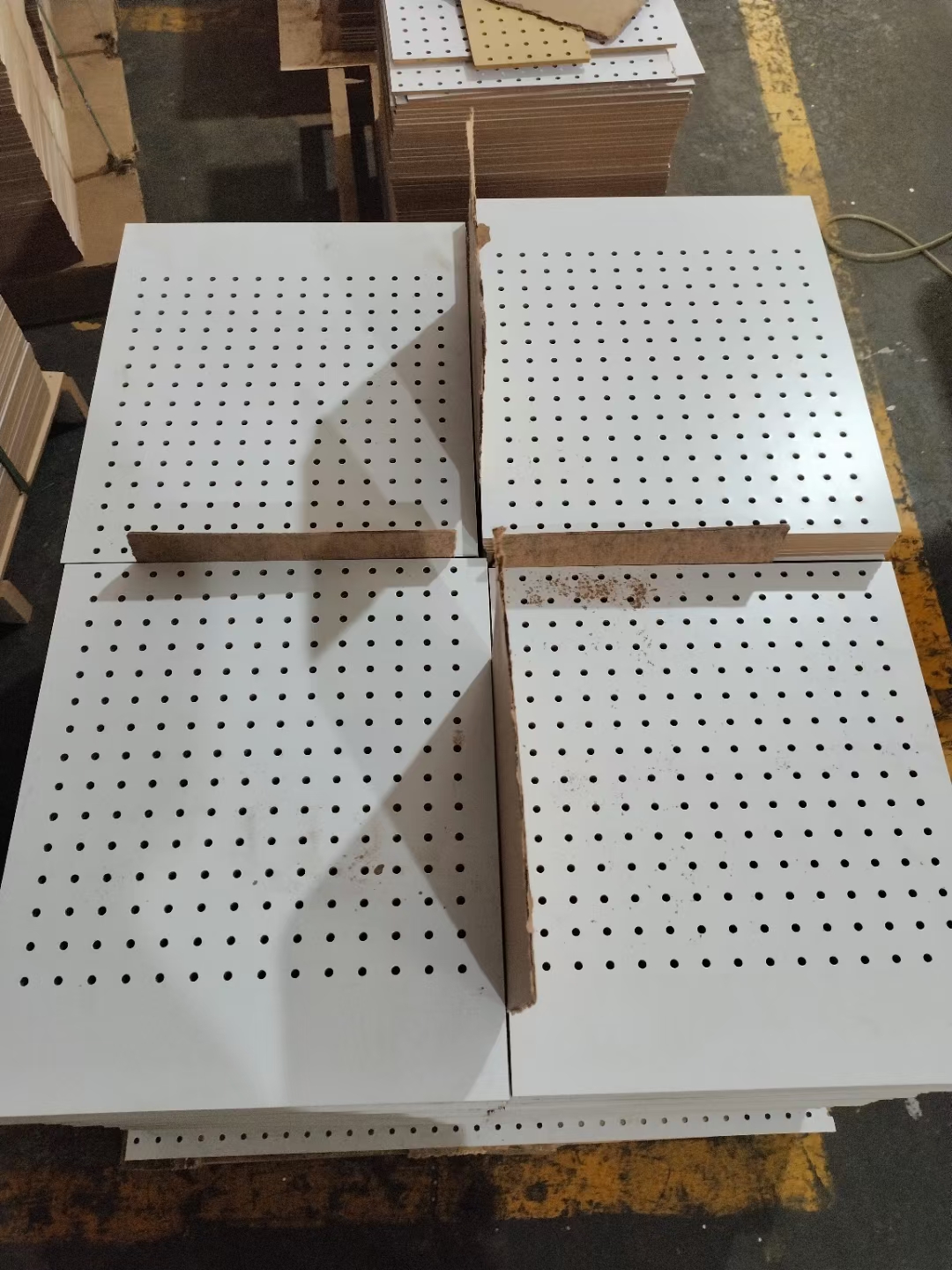
What Is MDF Really Made Of? Why Punch Holes in It? A Complete Guide to Perforated Medium Density Fiberboard for Acoustics and Decoration
What Is MDF Really Made Of? Why Punch Holes in It? A Complete Guide to Perforated Medium Density Fiberboard for Acoustics and Decoration
Overview
Medium density fiberboard (MDF) is a widely used engineered wood product made from wood fibers, adhesive, and additives, pressed under high temperature and pressure. It is not solid wood. When perforated, MDF becomes a functional acoustic component through the Helmholtz resonance principle: each hole and the air cavity behind it form a small resonator that dissipates sound energy at specific frequencies. This guide explains what MDF is, why perforation works acoustically, what hole parameters deliver optimal absorption, how international standards rate performance, and how perforated MDF performs in real projects. It also covers decorative benefits, formaldehyde and fire safety, a customer case study, FAQs, authoritative references, and full contact information.
Related Reading: Decorative Perforated Metal Panel | Jintong Instagram
1. What Is MDF Really Made Of?
MDF stands for Medium Density Fiberboard (also spelled Medium Density Fibreboard in British English). It is an engineered wood panel, not natural solid wood.
The manufacturing process begins by breaking down wood or plant fibers into individual fibers. These fibers are then mixed with adhesive resins and waterproofing agents, formed into a mat, and pressed under high temperature and pressure into uniform panels. Raw materials include branch wood, small-diameter logs, panel edges, sawdust, and other wood-processing residues.
In simple terms, MDF is made by taking wood back to its fibrous form and then re-pressing it into a board. Its density typically ranges from 500 to 880 kg/m³, with common thicknesses from 5 mm to 30 mm. Compared with natural wood, MDF has a more uniform structure, no decay or insect damage, and lower swelling and shrinkage.
MDF has a smooth, uniform, dense surface with no knots or grain defects. This homogeneous density distribution allows precision machining and fine surface finishing, and it generates less waste than many other substrates.
International Standards for MDF
MDF quality is governed by strict international standards.
In North America, ANSI A208.2-2016 covers MDF for interior applications. It specifies dimensional tolerances, physical and mechanical properties, and formaldehyde emission limits. The standard classifies MDF into grades 115, 130, and 155. Grade 155, the highest, requires modulus of rupture ≥ 27.9 N/mm², modulus of elasticity ≥ 2,792 N/mm², and internal bond strength ≥ 0.65 N/mm². For details, visit the Composite Panel Association standards page.
Mechanical testing follows ASTM D1037-12(2020), Standard Test Methods for Evaluating Properties of Wood-Base Fiber and Particle Panel Materials. This standard covers particleboard, MDF, hardboard, and oriented strand board. See the ASTM D1037 page.
In Europe, EN 622-5 governs MDF requirements. Formaldehyde emission classes are divided into E2, E1, E0, and SE0.
2. Why Perforate MDF? The Acoustic Mechanism
The core purpose of perforating MDF is sound absorption. More precisely, the perforation itself does not directly absorb sound. The complete absorption structure consists of the perforated panel, the air cavity behind it, and optionally an acoustic fabric or fleece.
When MDF is perforated, it forms a perforated panel resonant absorber. Each hole and the air cavity behind it act as a small Helmholtz resonator. In acoustic physics, the air plug in the hole behaves like a mass, and the air in the cavity behaves like a spring. When sound waves enter the cavity through the holes, the air oscillates in the hole necks. Viscous friction at the hole walls converts acoustic energy into heat. Near the resonance frequency, the oscillation amplitude is greatest, and energy dissipation is most efficient.
The approximate resonance frequency formula is:
f₀ = (c / 2π) × √(p / (t′ × D))
Where:
- c = speed of sound
- p = perforation rate (open area ratio)
- t′ = effective hole depth (panel thickness plus end correction)
- D = air cavity depth behind the panel
This formula reveals four core variables: hole diameter, perforation rate, panel thickness, and cavity depth.
If an acoustic fabric or thin felt is applied to the back, it forms a honeycomb-like closed cell structure that further blocks sound propagation and stabilizes absorption. According to AcousPlan’s perforated panel guide, a well-designed perforated absorber can achieve an NRC of 0.60 to 0.95. It is widely used in offices, concert halls, cinemas, schools, hospitals, and transportation hubs.
In acoustic design, perforated MDF systems can be tuned by adjusting cavity depth. Increasing cavity depth lowers the resonance frequency and improves low-frequency absorption. Decreasing it shifts absorption toward higher frequencies. This design flexibility makes perforated MDF an ideal choice when both acoustic performance and decorative appearance are required.
Related Reading: Perforated MDF Product Page
3. What Hole Pattern Works Best for Sound Absorption?
Hole diameter and perforation rate are the key parameters.
Researchers at the Chinese Academy of Forestry conducted impedance tube transfer function tests on perforated MDF. They systematically studied the effects of panel thickness, hole diameter, perforation rate, and cavity depth. The optimized process parameters were:
- Panel thickness: 15 mm
- Hole diameter: 3 mm
- Perforation rate: 3.14%–4.91%
- Cavity depth: 50 mm
With these parameters, the sound absorption coefficient peak exceeded 0.6, meeting the standard for acoustic absorption materials.
The same research noted that untreated wood-based panels typically have a sound absorption coefficient below 0.2, meaning poor acoustic performance. After perforation, absorption improves significantly.
General Rules
- Smaller hole diameter → higher resonance frequency and higher absorption peak. Small holes increase friction area between air and hole walls, improving energy conversion.
- Higher perforation rate → broader absorption band, but lower peak and resonance shifted toward higher frequencies. Below 5%, the absorption band is narrow but the peak is high, suitable for targeted noise frequencies. Between 5% and 15%, the band is moderate, with NRC typically between 0.60 and 0.80. This is the most common range for architectural acoustic panels.
- Deeper cavity → resonance moves toward lower frequencies, improving low-frequency absorption. For low-frequency noise control, cavity depths often exceed 100 mm.
Further research at Zhejiang A&F University found that adding side holes to perforated MDF can broaden the absorption band. Orthogonal tests identified the order of influence on absorption peak as: tilt angle > main hole diameter > perforation rate. The optimized parameters were main hole diameter 3 mm, perforation rate 3.14%, and tilt angle 30°.
Therefore, bigger holes and more holes are not always better. Parameters must be tuned to the actual noise reduction requirement. In real projects, acoustic simulation or small-sample testing should be used to confirm frequency characteristics before mass production.
Acoustic Rating Systems
ISO 11654 classifies sound absorbers into Classes A through E based on weighted sound absorption coefficient (αw). Class A (αw ≥ 0.90) is the highest; Class C (αw = 0.60–0.75) is moderate. Testing follows ISO 354 reverberation room methods. See the ISO 11654 standard page.
RPG Acoustic Systems offers the Perfecto® Micro MOTIF Panel, which uses a 3/4-inch (about 19 mm) MDF core, 0.4 mm holes, 2 mm staggered pitch, 50% micro-perforation, and fiberglass backing. It achieves NRC = 0.80–0.85, and up to NRC = 0.85 with Z-clip installation. The core material is UL GREENGUARD certified, with high recycled content, ultra-low emitting formaldehyde (ULEF), Class A fire rating, and FSC-certified MDF. See RPG Acoustic Systems.
Installation Tip: Perfecto® Micro MOTIF Panel installation options include Z-clip mounting, direct screw fixing, and ceiling systems with torsion springs or C-clips. Cavity depth starts at about 1-3/4 inches (44 mm) and can be adjusted. In practice, the installation system must match the acoustic design cavity depth. Insufficient cavity depth significantly reduces low-frequency absorption.
4. Decorative and Functional Benefits Beyond Acoustics
Perforated MDF delivers both decoration and function.
MDF has a smooth surface that accepts many finishes: melamine, wood veneer, paint, and more. The perforation array itself is a decorative element. In conference rooms, theaters, and studios, perforated MDF serves as both acoustic treatment and interior design.
Some projects use MDF as the core, with melamine facing, grooved on the front and drilled on the back, to create linear perforated decorative acoustic panels. By changing perforation rate, cavity size, and infill material, the desired absorption frequency characteristics can be achieved while maintaining an attractive surface. These panels are widely used in gymnasiums, concert halls, theaters, multi-function halls, and broadcast recording studios.
In practical projects, 15 mm B1-grade flame-retardant MDF with a matte melamine finish, Φ8 mm holes, triangular arrangement, and ≥20% perforation rate, with acoustic non-woven fabric on the back to prevent mineral wool fibers from escaping through the holes, can balance acoustic performance and visual appearance.
Perforation also provides some ventilation. In certain applications, perforated panels can serve as ventilation partitions or equipment guard substrates.
Related Reading: Jintong on Instagram
5. Environmental Performance: Formaldehyde Emission Standards
Because MDF is made from fibers and adhesives, formaldehyde emission is a major environmental concern.
In Europe, EN 13986 classifies wood-based panel formaldehyde emission into E2, E1, E0, and SE0. For MDF, E1 requires emission ≤ 8 mg/100 g. The EU Ecolabel sets stricter requirements for furniture: formaldehyde emission must be below 65% of the E1 limit. See the EU Ecolabel page.
In North America, ANSI A208.2-2016 requires MDF formaldehyde emission below 0.11 ppm for panels thicker than 8 mm, or 0.13 ppm for panels 8 mm or thinner. The California Air Resources Board (CARB) Phase 2 standard is also a key market requirement, verified through ASTM E1333 or ASTM D6007 large/small chamber tests. See the CARB composite wood products program.
Japan’s F☆☆☆☆ standard is one of the strictest formaldehyde emission levels globally, requiring ≤ 0.3 mg/L. It is roughly equivalent to European E0 and is among the most stringent standards worldwide.
For procurement, choose MDF substrates labeled E0 or F☆☆☆☆ and require third-party test reports. For kindergartens, hospitals, and sensitive environments, specify no-added-formaldehyde (NAF) MDF.
Fire Performance
Standard MDF can achieve B1 fire rating with flame-retardant treatment, or Class A under ASTM E84 with flame spread index ≤ 25 and smoke developed index ≤ 200. For public spaces, specify flame-retardant MDF.
6. Case Study: From Echo Problems to Acoustic Compliance
Background. A 400 m² multi-function meeting room in a city in eastern China was renovated in 2023. The original wall design used standard wood veneer panels. After commissioning, the room had obvious echo, poor speech clarity, and frequent complaints during video conferences that the other side “could not hear clearly.”
Diagnosis. An acoustic consultant measured the room and found the mid-frequency reverberation time (RT60) reached 1.8 seconds, far above the recommended 0.6–0.8 seconds for meeting rooms. The cause was large hard wall surfaces reflecting sound, with no effective absorption. Standard wood veneer panels have a sound absorption coefficient of only 0.10–0.15, offering almost no improvement.
Solution. The consultant recommended a perforated MDF solution: 15 mm E0-grade MDF, 3 mm holes, 4.91% perforation rate, 60° staggered arrangement, 50 mm cavity depth, filled with 50 mm centrifugal glass wool at 32 kg/m³, and acoustic non-woven fabric on the back. The finish was matte melamine wood grain to match the room’s design.
Result. After renovation, professional acoustic testing showed the mid-frequency reverberation time dropped to 0.75 seconds, and the Speech Transmission Index (STI) improved from 0.48 to 0.68, reaching “good” level. Video conference participants reported significantly improved speech clarity. The entire renovation took only 5 days without disrupting normal office use.
Want to know which acoustic solution suits your space? WhatsApp Inquiry | Connect with Andy Liu on LinkedIn
7. FAQ
Q1: Is perforated MDF the same as wood perforated acoustic panel?
Perforated MDF is one type of wood perforated acoustic panel. Wood acoustic panels also include plywood and solid wood substrates, but MDF is the most common because of its uniform structure and excellent machinability.
Q2: What perforation rate is best?
There is no single best rate. Below 5% is suitable for targeted noise reduction. 5%–15% is the most common range for architectural acoustic panels. 15%–25% suits broadband absorption. The choice depends on target frequency and cavity conditions.
Q3: Can perforated MDF be used for ceilings?
Yes. Installation methods include Z-clip mounting, direct screw fixing, and ceiling grid systems. For ceiling installation, ensure the cavity depth meets acoustic design requirements and consider panel self-weight on hanger rods.
Q4: Does perforation reduce MDF strength?
Yes, strength decreases to some extent, and higher perforation rates cause greater loss. For ceilings or large wall areas, use thickness of 15 mm or more, or add reinforcing ribs on the back.
Q5: What fire rating can perforated MDF achieve?
Standard MDF can achieve B1 with flame-retardant treatment, or Class A under ASTM E84. For public spaces, specify flame-retardant MDF.
Q6: Is perforated MDF formaldehyde safe?
Choosing E0 or F☆☆☆☆ substrate meets indoor environmental requirements. CARB Phase 2 and EN 13986 E1 are basic international market thresholds. EU Ecolabel products are stricter.
Q7: Can perforated MDF be used in humid environments?
Not recommended. MDF absorbs moisture and swells. Moisture-resistant MDF (MR10/MR50) can be used in moderately humid areas, but not for long-term water exposure.
8. Authoritative References & Further Reading
- ASTM D1037-12(2020) – Standard Test Methods for Evaluating Properties of Wood-Base Fiber and Particle Panel Materials: ASTM Official Website
- ANSI A208.2-2016 – Medium Density Fiberboard for Interior Applications: Composite Panel Association
- ISO 11654 – Acoustics — Sound absorbers for use in buildings — Rating of sound absorption: ISO Official Website
- ISO 354 – Acoustics — Measurement of sound absorption in a reverberation room: ISO Official Website
- AcousPlan – What Are Perforated Panels? Design Guide: AcousPlan
- RPG Acoustic Systems – Perfecto® Micro MOTIF Panel Technical Data: RPG Acoustic
- International Perforators Association (IPA) – Designers, Specifiers and Buyers Handbook of Perforated Metals: IPA Official Website
- METU – Adjustable Perforated Panels as Acoustic Solutions, Master’s Thesis: METU Thesis
- California Air Resources Board (CARB) – Composite Wood Products Program: CARB Official Website
- EU Ecolabel – Furniture and Wood-Based Products: EU Ecolabel
- Chinese Academy of Forestry – Sound Absorption Performance of Perforated MDF (research study)
- Zhejiang A&F University – Bionic Wood Structure Perforated Fiberboard Sound Absorption Performance (research study)
Contact Information
📞 Tel/WhatsApp: +86 180 2733 7739
📧 Email: jtsw58@gmail.com
🌐 Website: perforatedmetalpanel.com
📸 Instagram: instagram.com/jintongperforatedmetal
💬 WhatsApp: api.whatsapp.com/send?phone=8618027337739
🔗 LinkedIn: Andy Liu
📘 Facebook: facebook.com/me
▶️ YouTube: Jintong Channel
Have an acoustic renovation or custom furniture project requiring perforated MDF? Please provide space dimensions, target noise reduction requirements, finish requirements, and quantity list. Our engineers will reply with an acoustic solution and quotation within 24 hours.
Keyword Groups
#MDF #mediumdensityfiberboard #perforatedMDF #acousticMDF #soundabsorption #acousticpanel #perforatedacousticpanel #woodacousticpanel #perforatedpanel #decorativeacousticpanel #ceilingacousticpanel #wallacousticpanel #Helmholtzresonator #soundabsorptioncoefficient #perforationrate #NRC #NoiseReductionCoefficient #E0MDF #FSCcertifiedMDF #fireproofMDF #moistureproofMDF #acousticdesign #reverberationtime #interioracousticpanel #MDFpanel #MDFboard #perforatedMDFpanel #acousticceiling #acousticwall #soundproofing #noisecontrol #acoustictreatment #customacousticpanel #MDFmanufacturer #acousticpanelsupplier #ChinaMDF #perforatedwoodpanel #decorativeMDF #MDFacousticboard #acousticfelt
Theme Keywords: MDF, perforated MDF, acoustic MDF.
Customer Words: architects, interior designers, acoustic contractors, furniture manufacturers.
Object Words: meeting rooms, theaters, studios, offices.
Product Words: perforated acoustic panel, MDF acoustic board, decorative perforated panel.
Interactive Hook: Have you encountered echo, excessive reverberation, or poor speech clarity in your acoustic renovation projects? Leave a comment describing your space type and dimensions, and we will provide free acoustic solution advice and material parameter recommendations. The first 5 commenters will receive a complimentary acoustic simulation analysis from the Jintong team.