



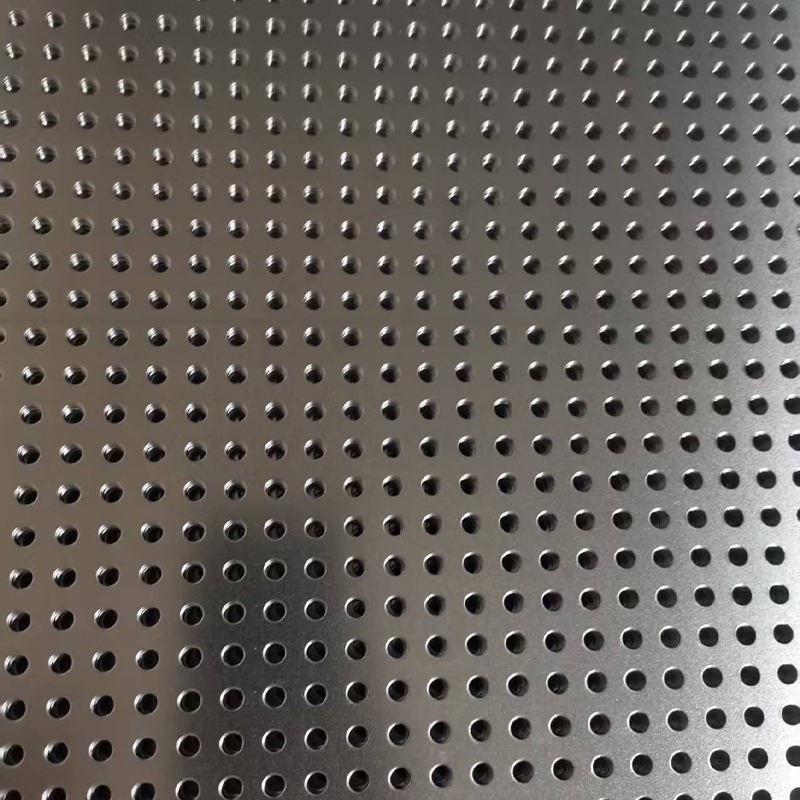
Will a Magnet Attract Stainless Steel Perforated Sheet? The Complete Guide to 201, 304, and 430 Magnetic Behavior
Will a Magnet Attract Stainless Steel Perforated Sheet? The Complete Guide to 201, 304, and 430 Magnetic Behavior
Overview
One of the most common misconceptions in the stainless steel industry is that “if a magnet sticks, it is not real stainless steel.” This belief has caused countless unnecessary disputes between buyers and suppliers, led to the rejection of perfectly good 304 material, and even resulted in costly project delays. The truth is that magnetic attraction in stainless steel is not a simple yes-or-no indicator of authenticity. It depends on the alloy’s crystal structure, its chemical composition, and — critically — the amount of cold working it has undergone during manufacturing.
This guide explains why 304 stainless steel perforated sheet can become magnetic after punching and bending, why 201 is inherently more magnetic than 304, why 430 is always strongly magnetic, and what testing methods you should actually use to verify material grade. Whether you are a procurement manager sourcing perforated panels for a construction project, an engineer specifying material for a filtration system, or a distributor answering customer questions, this article will give you the scientific foundation to address the “magnet test” question with confidence.
1. The Science Behind Stainless Steel Magnetism
1.1 Crystal Structure Determines Magnetic Behavior
The magnetic properties of stainless steel are fundamentally determined by its microstructure. Stainless steels are classified into five families — austenitic, ferritic, martensitic, duplex, and precipitation-hardening — and each family has a distinct crystal structure that governs its response to a magnetic field.
Austenitic stainless steels (300 series, including 304 and 316) have a face-centered cubic (FCC) crystal structure. In the fully annealed condition, this structure is paramagnetic, meaning it is essentially non-magnetic. The DC magnetic permeability of well-annealed austenitic stainless steel ranges from 1.003 to 1.005 when measured at magnetizing forces of 200 oersteds (1 kA/m).
Ferritic stainless steels (400 series, including 430) have a body-centered cubic (BCC) crystal structure and are ferromagnetic in all conditions. Type 430 is magnetic in both annealed and cold-rolled tempers, with a magnetic permeability of approximately 800.
Martensitic stainless steels (410, 420, 440) also have a BCC or body-centered tetragonal structure and are strongly magnetic.
The International Stainless Steel Forum (ISSF) and the Australian Stainless Steel Development Association (ASSDA) both emphasize that magnetic response is a function of microstructure, not a definitive indicator of alloy composition. A widely accepted but sometimes misunderstood test is the magnet test — duplex, super duplex, martensitic, and ferritic stainless steels are strongly attracted to a magnet, while annealed austenitic stainless steels are not.
1.2 Why Cold Working Creates Magnetism in 304
Here is where the confusion begins. Type 304 stainless steel is austenitic and non-magnetic in the annealed condition. But when it undergoes cold working — such as punching, bending, shearing, or rolling — the crystal structure undergoes a partial transformation from austenite to martensite, a ferromagnetic phase.
Research published in the Journal of Magnetism and Magnetic Materials demonstrated that nuclear-grade 304 stainless steel is nonmagnetic under normal conditions but changes to a partially ferromagnetic state associated with martensitic transformation under plastic deformation. The magnetic moment of 304 stainless steel increased with increasing cold work rate and decreased with increasing annealing temperature.
Carpenter Technology, a leading specialty alloy manufacturer, confirms this: for certain grades such as Types 302 and 304, the increase in magnetic permeability can be appreciable, resulting in these grades being weakly ferromagnetic in the heavily cold-worked condition.
How much magnetic permeability increases after cold working:
| Condition | Magnetic Permeability (approximate) |
|---|---|
| 304 annealed | 1.003–1.008 |
| 304 (80% cold worked) | Significantly increased |
| 301 (55% cold worked) | Higher than 304 at equivalent reduction |
| 316 (34% cold worked) | Very low — almost no magnetic response |
Research data shows that the magnetic mass susceptibility of 301 at 55% cold work is 0.00165, while 304 at 80% cold work is 0.000380, and 316 at 34% cold work is only 0.0000027. This means that 301 becomes the most magnetic, 304 moderately magnetic, and 316 almost non-magnetic after cold working.
1.3 Why Nickel Content Matters
The susceptibility of a particular grade to becoming ferromagnetic when cold worked depends on the stability of the austenite, which in turn depends on chemical composition. Nickel is the key austenite stabilizer. Higher nickel content means greater austenite stability, which means less martensite formation during cold working, which means lower magnetic permeability.
Carpenter Technology’s technical guide explains this relationship clearly: the higher nickel grades, such as Type 384, exhibit lower magnetic permeabilities than lower nickel grades such as Type 304 when cold worked in equivalent amounts. The high-manganese, high-nitrogen alloys, such as 18Cr-2Ni-12Mn, are also noted for maintaining low permeability after heavy deformation.
This principle directly explains why 316 (containing 10–14% nickel and 2–3% molybdenum) is far less magnetic after cold working than 304 (containing 8–10.5% nickel). Lawson Products’ technical report confirms: “Grade 316 has very low magnetic properties and shows almost no response to a magnet after cold working, while 18-8 grades (302, 303, 304) exhibit quite a strong response to a magnet”.
Related Reading: Stainless Steel Perforated Sheet Product Page | Jintong Instagram
2. Perforated Sheet: The Double Effect of Magnetic Transformation
2.1 Two Independent Magnetic Sources
A stainless steel perforated sheet is exposed to two independent magnetic transformation processes during manufacturing:
First: Cold rolling at the mill. Perforated sheets are typically produced from cold-rolled coil. The rolling process itself introduces deformation-induced martensite. The higher the rolling reduction (thinner the final gauge), the greater the martensite content and the stronger the magnetic response.
Second: Punching and forming. The CNC punching process that creates the hole pattern is a severe local cold-working operation. Every punched hole edge undergoes plastic deformation, creating a ring of martensitic material around the hole. The same applies to bending and folding operations — the bend radius becomes a magnetic zone. After perforating and bending, the cumulative cold work can be substantial, making an originally non-magnetic 304 sheet clearly attractive to a magnet.
2.2 Why the Hole Edge Is the Most Magnetic Area
When a punch strikes the stainless steel sheet, the material immediately surrounding the punched hole experiences extreme shear deformation. The strain at the hole edge can reach 30–50% or more, depending on punch clearance and tooling condition. This level of deformation is more than sufficient to induce significant martensitic transformation in 304 stainless steel.
Research on cold-rolled AISI 304L steel found that cold deformation can increase the amount of magnetic martensite by 3–4%, and that the intrinsic saturation magnetization of the martensite produced by cold deformation in 304 stainless steel is typically 160.4 emu/g. While 3–4% martensite may sound small, it is more than enough to produce a noticeable magnetic attraction.
Practical observation: If you place a magnet on a 304 perforated sheet, the strongest attraction will typically occur at the hole edges and along any bend lines. The flat, unworked areas between holes will show much weaker or no magnetic response.
2.3 The 600-Hour Salt Spray Test Evidence
The International Perforators Association (IPA) conducted controlled salt spray tests under ASTM B117 conditions to compare perforated and expanded metals. Carbon steel began corroding within 24 hours and was entirely removed by 48 hours. Galvanized expanded metal failed at 72 hours. Galvanized perforated metal showed first failure at 240 hours and lasted up to 600 hours. This test confirms that perforated metal has superior long-term corrosion performance — but the key insight for our discussion is that the cutting and forming processes that create perforations also create the magnetic susceptibility that confuses buyers.
3. Grade-by-Grade Magnetic Behavior Comparison
3.1 304 Austenitic Stainless Steel (Most Common)
Annealed condition: Essentially non-magnetic. Magnetic permeability 1.003–1.008.
After cold working (punching, bending): Weakly ferromagnetic. Magnetic permeability can increase appreciably. A pen magnet will attract, and in heavily cold-worked conditions, the sheet may pick up small objects such as paper clips.
Key takeaway: A magnetic 304 perforated sheet is not fake. The magnetism is a normal consequence of the manufacturing process.
3.2 201 Stainless Steel (Manganese-Substituted)
201 stainless steel was developed as a lower-cost alternative to 304, replacing some of the expensive nickel with manganese and nitrogen. Its composition typically contains 16–18% chromium, 3.5–5.5% nickel, and 5.5–7.5% manganese.
Annealed condition: Essentially non-magnetic.
After cold working: Becomes magnetic. Carpenter Technology confirms that CarTech 201 Modified stainless is essentially nonmagnetic in the annealed condition but becomes magnetic after cold working to high-strength levels.
Because 201 has lower nickel content than 304, it has lower austenite stability, which means more martensite forms during cold working. This makes 201 perforated sheet noticeably more magnetic than 304 under equivalent processing conditions.
Cost context: 201 is cheaper than 304 because of the lower nickel content, but it also has lower corrosion resistance — roughly comparable to 430 in some environments, and significantly inferior to 304 in chloride exposure.
3.3 430 Ferritic Stainless Steel (Always Magnetic)
Type 430 is a chromium ferritic stainless steel containing approximately 16–18% chromium with no nickel. It is magnetic in all conditions — annealed, cold-rolled, or otherwise.
Magnetic permeability: Approximately 800.
Corrosion resistance: Moderate. Type 430 is resistant to atmospheric corrosion and fresh water but not resistant to most salts and sea water.
Typical use in perforated sheet: 430 is rarely used for decorative perforated panels in architectural applications because of its lower corrosion resistance and strong magnetic response. It is more commonly found in automotive trim, appliance components, and indoor applications where corrosion exposure is minimal.
3.4 Comparison Summary
| Grade | Crystal Structure | Annealed Magnetism | After Cold Work | Ni Content | Corrosion Resistance |
|---|---|---|---|---|---|
| 304 | Austenitic (FCC) | Non-magnetic | Weakly magnetic | 8–10.5% | Excellent |
| 316 | Austenitic (FCC) | Non-magnetic | Almost no response | 10–14% | Superior |
| 201 | Austenitic (FCC) | Non-magnetic | Magnetic (stronger than 304) | 3.5–5.5% | Moderate |
| 430 | Ferritic (BCC) | Magnetic | Magnetic | 0% | Moderate |
4. Why the “Magnet Test” Is Unreliable for Grade Identification
4.1 The NRC’s Position
The U.S. Nuclear Regulatory Commission (NRC) provides clear guidance on material verification. In its documentation, the NRC states: “A magnet test in conjunction with portable X-ray fluorescence could help identify if the material is a non-cold-worked 300 series, aluminum, copper alloy, or titanium.” Critically, the NRC notes: “Used alone, a magnet test will not provide conclusive evidence of material composition. When used in combination with another test or inspection, a magnet test may be useful to sort two known materials where one is magnetic and the other is nonmagnetic”.
4.2 The ASSDA’s Position
The Australian Stainless Steel Development Association (ASSDA) publishes a technical FAQ specifically addressing magnetic effects. ASSDA acknowledges that magnet testing is “a widely accepted but sometimes misunderstood test” and warns that while annealed austenitic stainless steels are not attracted to a magnet, cold-worked austenitic grades may be slightly magnetic with a greater effect if the deformation is severe.
4.3 The Common Misconception
Many procurement managers and quality inspectors operate under a simple rule: “Magnet sticks = fake 304.” This rule is not only incorrect but can lead to serious consequences:
- Rejecting genuine 304 perforated sheet because the punching and bending processes have made it magnetic.
- Accepting fake material that has been annealed or processed to appear non-magnetic, even though its chemical composition does not meet 304 specification.
- Paying a premium for 316 when the application does not require the higher nickel content, simply because the customer equates “non-magnetic” with “better quality.”
4.4 What Actually Causes False Positives and False Negatives
False positive (magnet sticks but material is 304): Caused by deformation-induced martensite from cold rolling, punching, bending, shearing, or even aggressive surface grinding or polishing.
False negative (magnet does not stick but material is not 304): Some 201 or 202 grades with high manganese and nitrogen content can maintain low permeability even after moderate cold working. A non-magnetic response does not guarantee 304 or 316.
The only reliable approach: Use a combination of methods — magnet test as a preliminary sorting tool, followed by chemical composition analysis using XRF, OES, or spot testing.
5. Correct Methods for Stainless Steel Grade Verification
5.1 X-ray Fluorescence (XRF) Analysis
Handheld XRF analyzers are the most widely used portable instruments for positive material identification (PMI) in the field. These devices can identify alloy composition in 1–2 seconds without cutting or damaging the sample. Modern handheld XRF analyzers, such as the Hitachi X-MET8000, Bruker S1 TITAN, and Olympus VANTA series, are optimized for high-speed grade identification of stainless steel and special alloys.
Key capabilities:
- Identifies chromium, nickel, molybdenum, and other alloying elements
- Distinguishes 304 from 316 by detecting molybdenum content
- Differentiates 200 series from 300 series by manganese content
- Non-destructive and portable for on-site inspection
Limitation: XRF cannot measure carbon content, which limits its ability to distinguish 304 from 304L or 316 from 316L.
5.2 Optical Emission Spectrometry (OES)
OES provides precise measurement of individual elements, including carbon, nitrogen, sulfur, and other low-atomic-mass elements. It is particularly useful for distinguishing between standard and low-carbon grades (304 vs. 304L, 316 vs. 316L). However, OES equipment is generally laboratory-based and not as portable as XRF.
5.3 Chemical Spot Testing (Molybdenum Spot Test)
The molybdenum spot test is a simple, low-cost chemical method for distinguishing 316 from 304. A drop of test solution is applied to a clean surface. If the material contains molybdenum (as in 316), the solution turns brown within approximately 3 minutes. If it remains yellow, the material is likely 304.
Manganese spot test: This test can detect the presence of manganese, which is high in 200 series grades and low in 300 series grades. It is useful for distinguishing 201 from 304.
5.4 ASTM A342 — Magnetic Permeability Measurement
For applications where magnetic permeability is a critical design parameter (such as instrumentation housings or magnetic shielding), ASTM A342/A342M provides standard test methods for measuring the permeability of weakly magnetic materials. This standard covers four procedures for determining relative permeability of materials with permeability not exceeding 6.0, and explicitly notes that austenitic stainless steels may be weakly ferromagnetic.
5.5 Summary of Testing Methods
| Method | What It Detects | Portability | Cost | Best For |
|---|---|---|---|---|
| Magnet | Ferromagnetic response | Excellent | Very low | Preliminary sorting only |
| XRF | Elemental composition | Excellent | Moderate | On-site PMI, 304 vs. 316 |
| OES | Full composition incl. C, N | Limited | High | Lab-grade verification |
| Mo Spot | Molybdenum presence | Excellent | Low | 304 vs. 316 distinction |
| Mn Spot | Manganese presence | Excellent | Low | 200 vs. 300 series |
| ASTM A342 | Magnetic permeability | Limited | Moderate | Specification compliance |
6. Case Study: From Rejected Shipment to Repeat Order
Background. A European distributor of architectural perforated metal panels placed an initial order for 2,000 m² of 304 stainless steel perforated sheet for a commercial building facade project in the Netherlands. The panels were 2.0 mm thick with Φ6 mm round holes in a 60° staggered arrangement, folded on all four sides.
The Problem. When the shipment arrived at the port, the distributor’s quality inspector performed a magnet test on several panels. The magnet stuck — particularly along the folded edges and around the hole patterns. The inspector immediately flagged the shipment as “non-compliant” and threatened to reject the entire order, claiming the material was not genuine 304.
The Resolution. The supplier arranged for a third-party inspection using a handheld XRF analyzer. The results confirmed the chemical composition was within the 304 specification range: 18.2% chromium, 8.1% nickel, and less than 0.08% carbon. The inspector also tested a flat, unworked section of the same panel, where the magnet showed negligible attraction — confirming that the magnetism was concentrated at the cold-worked areas.
The distributor’s technical team was educated on deformation-induced martensitic transformation. They learned that the magnetic response at the hole edges and bend lines was a predictable consequence of the punching and folding processes, not an indication of material substitution.
The Result. The shipment was accepted without modification. The distributor subsequently placed three repeat orders totaling 8,000 m² over the following 18 months. They also updated their incoming inspection procedure to replace the magnet test with XRF verification for all stainless steel perforated sheet purchases.
What this case demonstrates: The magnet test is not a reliable acceptance criterion for stainless steel perforated sheet. Deformation-induced martensite from punching and bending will cause genuine 304 to exhibit magnetic attraction. XRF analysis provides definitive grade confirmation.
Need help verifying your stainless steel perforated sheet? Contact Jintong for technical support | Connect with Andy Liu on LinkedIn
7. Practical Recommendations for Buyers and Specifiers
7.1 When Magnetism Matters
For most architectural, decorative, and filtration applications, weak magnetic attraction in 304 perforated sheet is not a functional concern. The material’s corrosion resistance, strength, and appearance are unaffected by the presence of 3–4% deformation-induced martensite.
However, there are specific applications where magnetic permeability is a critical design parameter:
- MRI rooms and magnetic shielding enclosures: Even weak ferromagnetism can distort magnetic fields.
- Electron microscopes and sensitive instrumentation: Magnetic components can interfere with electron beam trajectories.
- Some medical devices and nuclear applications: Strict magnetic permeability limits may apply.
For these applications, specify 316L or high-nickel austenitic grades that maintain low permeability even after cold working. For extreme requirements, solution annealing after forming can restore the non-magnetic austenitic structure.
7.2 What to Specify on Purchase Orders
To avoid disputes, include the following language in procurement specifications for stainless steel perforated sheet:
- Chemical composition requirements: Reference ASTM A240 or EN 10088 for the specific grade.
- Magnetic permeability requirements: If magnetic response is a concern, specify a maximum relative permeability value and reference ASTM A342 test methods.
- Annealing condition: Specify whether solution-annealed material is required, and whether post-forming annealing is required.
- Verification method: Specify XRF or OES analysis for grade confirmation, not magnet testing.
7.3 How to Respond to Customer Concerns
If a customer questions the authenticity of 304 perforated sheet based on magnetic attraction, the correct response is:
- Acknowledge the observation — the magnet does stick, and that is normal.
- Explain the mechanism — cold working from punching and bending transforms some austenite to martensite, which is ferromagnetic.
- Offer verification — provide XRF or OES test reports confirming chemical composition.
- Demonstrate the difference — test a flat, unworked section of the same sheet to show that the base material is non-magnetic.
Related Reading: Stainless Steel Perforated Sheet Product Page | Jintong on Instagram
8. Frequently Asked Questions
Q1: Is 304 stainless steel perforated sheet supposed to be magnetic?
In the annealed condition, no. After punching and bending, yes — it can become weakly magnetic. This is a normal and expected consequence of cold working, not a defect or indication of fake material.
Q2: Can I use a magnet to tell 304 from 201?
No. Both grades are non-magnetic when annealed and both become magnetic after cold working. The degree of magnetism depends on the amount of cold work and the specific composition. Use XRF or manganese spot testing to distinguish them.
Q3: Is 316 stainless steel perforated sheet magnetic?
316 has higher nickel content and is more stable against martensitic transformation. After cold working, 316 shows almost no magnetic response, while 304 exhibits a noticeable response. This difference is one practical way to distinguish the two grades, but XRF confirmation is still recommended.
Q4: Why is the magnetism stronger at the hole edges?
The punching process creates severe local plastic deformation at the hole periphery. This deformation induces martensitic transformation, making the hole edge the most magnetic area of the sheet.
Q5: Can the magnetism be removed?
Yes. Solution annealing followed by water quenching can restore the austenitic structure and eliminate the magnetic response. However, this process will also reduce tensile properties and may cause distortion, so it is not suitable for all applications.
Q6: What is the magnetic permeability of 304 stainless steel?
Annealed 304 has a relative permeability of approximately 1.003–1.008. After heavy cold working, this value can increase significantly, though it remains far below that of ferritic or martensitic grades.
Q7: Should I reject a shipment of 304 perforated sheet if a magnet sticks?
Absolutely not. A magnet test alone is not a valid basis for rejection. Require XRF or OES chemical composition analysis before making any rejection decision.
Q8: Does magnetism affect corrosion resistance?
The presence of deformation-induced martensite can slightly reduce corrosion resistance in the affected areas, because martensite is less corrosion-resistant than austenite. However, the effect is generally minor for 304 in atmospheric environments. In highly corrosive environments, 316L is preferred regardless of magnetic considerations.
9. Authoritative References & Further Reading
- Carpenter Technology – Guide to Selecting Stainless Steels (magnetic behavior of austenitic, ferritic, and martensitic grades): Carpenter Technology
- ASSDA Technical FAQ 3 – Magnetic Effects of Stainless Steels: ASSDA
- ASSDA Technical FAQ 4 – Testing for Grade Confirmation: ASSDA PDF
- U.S. Nuclear Regulatory Commission – Material Verification Guidelines (magnet test limitations): NRC
- ASTM A342/A342M-26 – Standard Test Methods for Permeability of Weakly Magnetic Materials: ASTM
- Lawson Products – Magnetic Permeability of Stainless Steel (grade-by-grade comparison): Lawson Products
- Hamilton Precision Metals – Stainless Steel 430 Technical Data Sheet: HP Metals
- Aalco Metals – 200 Series Stainless Steel Datasheet: Aalco
- Hitachi High-Tech – Handheld XRF Analyzer X-MET8000 for Stainless Steel Grade Identification: Hitachi High-Tech
- Bruker – S1 TITAN PMI Gun for Positive Material Identification: Bruker
- International Perforators Association (IPA) – Designers, Specifiers and Buyers Handbook of Perforated Metals: IPA
- Zahner – Architectural Perforated Stainless Steel Facade Projects: Zahner
- World Stainless – Stainless Steel in Architectural Applications: World Stainless
Contact Information
📞 Tel/WhatsApp: +86 180 2733 7739
📧 Email: jtsw58@gmail.com
🌐 Website: perforatedmetalpanel.com
📸 Instagram: instagram.com/jintongperforatedmetal
💬 WhatsApp: api.whatsapp.com/send?phone=8618027337739
🔗 LinkedIn: Andy Liu
📘 Facebook: facebook.com/me
▶️ YouTube: Jintong Channel
Have questions about stainless steel perforated sheet magnetic behavior or need material verification support? Our technical team can provide XRF test reports and material certificates for all stainless steel perforated sheet orders. Contact us with your grade, thickness, and hole pattern requirements for a quotation and technical consultation within 24 hours.
Keyword Groups
#stainlesssteelperforatedsheet #perforatedstainlesssteel #304stainlesssteel #316stainlesssteel #201stainlesssteel #430stainlesssteel #magneticstainlesssteel #stainlesssteelmagnetictest #coldworkedstainlesssteel #deformationinducedmartensite #austeniticstainlesssteel #ferriticstainlesssteel #martensiticstainlesssteel #magneticpermeability #XRFanalysis #OESanalysis #PMItesting #positivematerialidentification #stainlesssteelgradeverification #magnetictestlimitations #perforatedmetal #perforatedplate #perforatedpanel #architecturalperforatedpanel #decorativeperforatedmetal #perforatedfacadepanel #stainlesssteelperforatedplate #perforatedsheetmanufacturer #stainlesssteelsupplier #metalperforation #CNCpunching #holepattern #perforatedmetalspecification #ASTMA342 #ASTMA240 #EN10088 #magneticpermeabilitytest #stainlesssteelgradeidentification #MoSpottest #MnSpottest #perforatedmetalChina
Theme Keywords: stainless steel perforated sheet, magnetic stainless steel, 304 magnetic test, deformation-induced martensite
Customer Words: procurement managers, quality inspectors, engineers, distributors, architects
Object Words: architectural facades, filtration systems, decorative panels, equipment enclosures, magnetic shielding
Product Words: 304 perforated sheet, 316 perforated sheet, 201 perforated sheet, cold-worked stainless steel, XRF-verified material
Interactive Hook: Have you ever encountered a situation where a magnet stuck to “304” stainless steel and caused confusion or a rejected shipment? Share your experience in the comments below. Our technical team will provide free material verification guidance and XRF test report interpretation for your specific case. The first 5 commenters will receive a complimentary material grade verification analysis from the Jintong team.