

Supermarket Perforated Metal Panel Procurement Guide: Material Selection, Specifications, Surface Treatment, and Installation Quality Control
Supermarket Perforated Metal Panel Procurement Guide: Material Selection, Specifications, Surface Treatment, and Installation Quality Control
Overview
Supermarket perforated metal panels are used in shelving back panels, product display trays, ventilation screens, decorative partitions, and checkout counter guards. Unlike industrial perforated sheet, supermarket applications demand a careful balance of load-bearing capacity, appearance, corrosion resistance, flatness, and safety. The wrong material choice can lead to rust in fresh-food zones, sagging display trays, scratched product packaging, or costly replacement within a few years.
This guide provides a deep, practical procurement framework covering cold-rolled steel with powder coating, galvanized steel, 304 stainless steel, and aluminum alloy perforated panels. It explains sheet thickness selection, hole diameter and pattern design, surface treatment options, dimensional tolerances, reinforcement methods, fabrication details, packaging and inspection requirements, and quotation/contract clauses. A real-world case study, FAQ, authoritative references, and a complete keyword set are included for procurement teams, supermarket fit-out contractors, and facility managers.
Related Reading: Perforated Metal Panel Product Page | Jintong Instagram
1. Material Selection: Cold-Rolled Steel, Galvanized Steel, 304 Stainless Steel, and Aluminum
Supermarket environments vary significantly. A dry ambient aisle has very different corrosion exposure compared with a fresh-food or seafood zone. Material selection must be driven by the specific area, load requirement, and aesthetic expectation.
1.1 Cold-Rolled Steel + Powder Coating
Best for: Dry indoor zones, standard shelving back panels, decorative screens.
Cold-rolled steel with electrostatic powder coating offers the best cost-performance ratio for dry supermarket areas. It accepts a wide range of colors, including white and gray, and provides a smooth, uniform finish. The steel substrate offers good rigidity and impact resistance.
Limitations: Cold-rolled steel is vulnerable to rust in humid or wet environments. If the coating is scratched or the cut edges are not properly protected, rust can develop quickly. It is not suitable for fresh-food display areas, seafood counters, or areas with frequent washing.
Procurement note: Specify a minimum coating thickness of 60–80 μm and require edge treatment or touch-up paint on all cut edges.
1.2 Galvanized Steel
Best for: Fresh-food zones, back-of-house areas, ventilation screens.
Galvanized steel offers better corrosion resistance than cold-rolled steel because the zinc coating acts as a sacrificial anode. It is suitable for fresh-food areas where humidity is higher. However, galvanized steel has a limited color range—typically metallic gray—and is generally not used for decorative color-matched panels.
Limitations: Cut edges and punched hole edges expose the steel core. If the zinc coating is breached, red rust can develop. For exterior or high-humidity applications, post-galvanizing or additional coating is recommended.
Technical reference: The American Galvanizers Association provides detailed guidance on galvanic corrosion and zinc coating performance. For more information, visit galvanizeit.org.
1.3 304 Stainless Steel
Best for: Fresh-food, seafood, aquatic, and high-humidity areas.
304 stainless steel offers the highest corrosion resistance among the common supermarket panel materials. It is ideal for seafood counters, aquatic product display areas, and any zone exposed to frequent moisture or cleaning chemicals. It is also easy to clean and maintain.
Limitations: Higher cost. 304 stainless steel can become weakly magnetic after punching and bending due to deformation-induced martensite, but this does not indicate fake material. Grade verification should be performed by XRF or OES analysis, not by magnet test. For more on this topic, see the ASSDA Technical FAQ on magnetic effects.
1.4 Aluminum Alloy Perforated Panel
Best for: Decorative partitions, advertising back panels, ceiling perforated panels, lightweight screens.
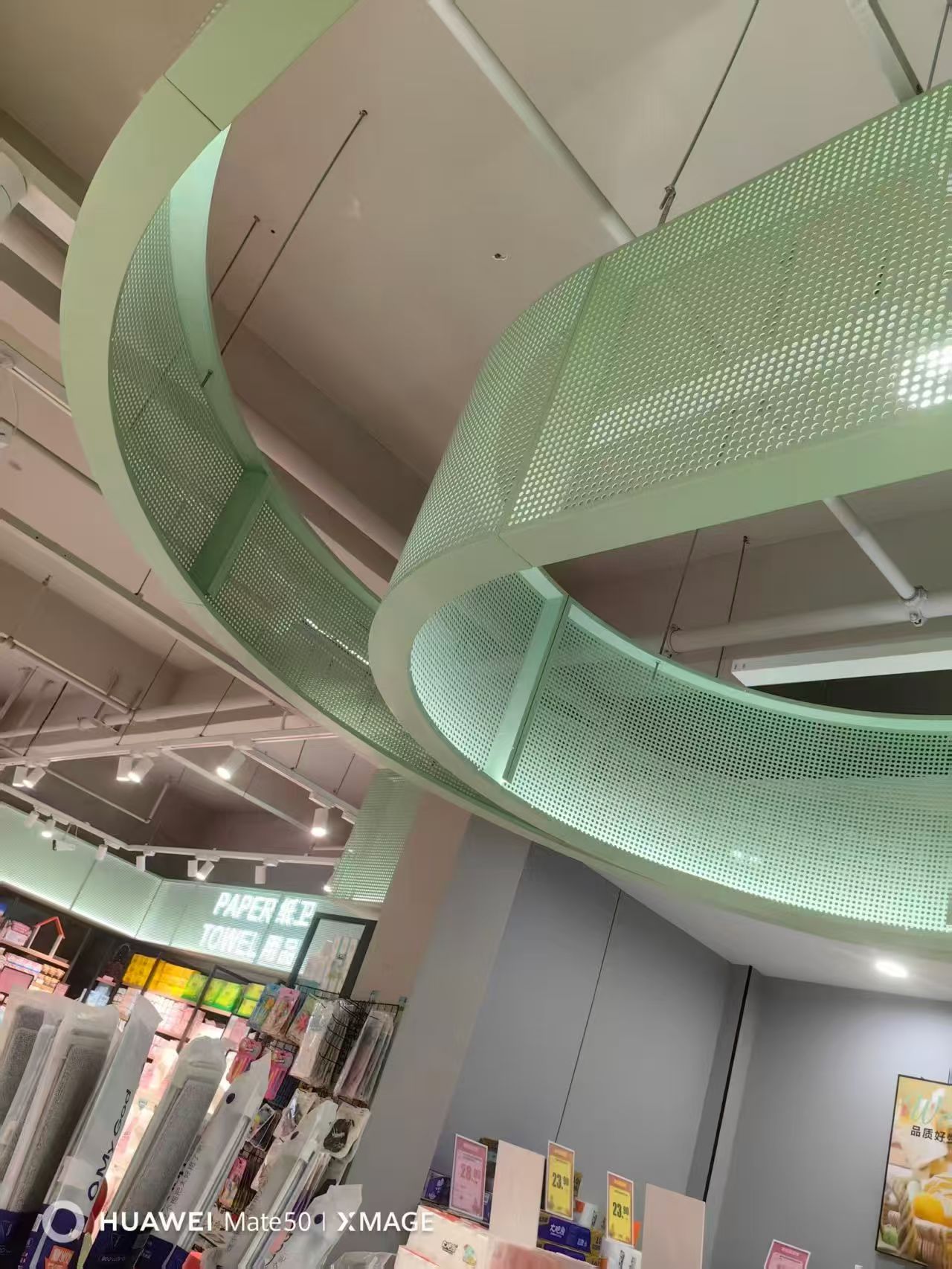
Aluminum alloy perforated panels offer significant advantages: light weight, natural corrosion resistance, excellent formability, and superior color finishing. Aluminum can be bent, curved, and shaped into complex designs. With powder coating or anodizing, it achieves a high-end appearance suitable for modern supermarket interiors.
Limitations: Aluminum has lower hardness and load-bearing capacity than steel. It is not suitable for load-bearing display trays. It is also more prone to denting from impact. Large aluminum panels may require reinforcing ribs on the back to maintain flatness.
Procurement note: For large decorative panels, specify reinforcing ribs or folded edges to reduce deflection. For high-end supermarket projects, anodizing offers better wear and colorfastness than standard powder coating, though at higher cost.
1.5 Material Comparison Table
| Material | Corrosion Resistance | Load Capacity | Aesthetic Options | Relative Cost | Best Supermarket Use |
|---|---|---|---|---|---|
| Cold-rolled steel + powder coating | Moderate | High | Excellent color range | Low | Dry shelving back panels, decorative screens |
| Galvanized steel | Good | High | Limited (gray metallic) | Low–Medium | Fresh-food zones, ventilation screens |
| 304 stainless steel | Excellent | High | Brushed, mirror, coated | High | Seafood, aquatic, high-humidity areas |
| Aluminum alloy | Excellent | Low–Moderate | Excellent, anodizing available | Medium–High | Decorative partitions, ceilings, ad back panels |
Related Reading: Custom Perforated Metal Solutions
2. Sheet Thickness, Hole Diameter, and Hole Pattern
2.1 Sheet Thickness
For supermarket applications, thickness selection depends on the function:
- Decorative shelving back panels: 0.8–1.5 mm
- Load-bearing display trays: ≥2.0 mm (steel recommended; aluminum not recommended for load-bearing trays)
- Ventilation screens and decorative partitions: 1.0–1.5 mm
- Checkout counter guards: 1.5–2.0 mm
Thinner sheets reduce weight and cost but are more prone to deformation. For large panels, thickness should be increased or reinforcing ribs added.
2.2 Hole Diameter and Pattern
- Round holes: Most common, aesthetically pleasing, suitable for most supermarket applications.
- Slotted holes: Better ventilation, suitable for ventilation screens and fresh-food zones.
- Common hole diameters: Φ3–8 mm.
- Open area: Typically 20%–40% for decorative panels; higher open area improves ventilation but reduces strength.
The International Organization for Standardization provides technical requirements for industrial perforated plates in ISO 10630:1994. For supermarket decorative panels, dimensional tolerances should be agreed upon between buyer and supplier.
2.3 Critical Requirement: No Burrs
Every punched hole must be free of burrs on both sides. Burrs can cut staff, damage product packaging, and create corrosion initiation points. Specify deburring or tumbling as a mandatory production step. For stainless steel and aluminum, edge quality is especially important for appearance and safety.
3. Surface Treatment
3.1 Powder Coating (Electrostatic Powder Spraying)
Powder coating is the most common surface treatment for cold-rolled steel and aluminum perforated panels in supermarkets. It offers a wide color range, uniform finish, and good adhesion when properly pretreated. For aluminum, powder coating provides excellent color and texture.
Quality check: Inspect for missed coating, sagging, orange peel, and edge coverage. Cut edges should be protected or touched up.
3.2 Galvanizing
Galvanizing is used only for steel panels. It provides corrosion protection but cannot achieve a rich color range. It is suitable for fresh-food zones and back-of-house areas where appearance is secondary.
3.3 Anodizing (Aluminum)
Anodizing is an electrochemical process that creates a durable, wear-resistant oxide layer on aluminum. It offers excellent colorfastness and a premium metallic appearance. It is more expensive than powder coating and is typically used for high-end supermarket decorative panels.
Technical reference: German standard DIN 24041:2022-06 provides dimensional and tolerance requirements for perforated plates, including flatness and burr height. This standard can be referenced when specifying high-quality supermarket panels.
3.4 Acceptance Criteria
- No missed coating or bare spots
- No sagging, runs, or blisters
- Uniform color and gloss
- Edges properly treated and protected
- Protective film applied for transportation
Related Reading: Jintong Instagram – Surface Finish Examples
4. Dimensional Tolerances and Flatness
Dimensional accuracy is critical for on-site installation. If panel length, width, or hole pitch deviates beyond tolerance, the panels will not fit the supporting frame, and rework costs will escalate.
Recommended tolerances:
- Length and width: ±1.0 mm for panels under 1,000 mm; ±1.5 mm for larger panels
- Hole pitch: ±0.5 mm
- Diagonal difference: ≤2.0 mm
- Flatness: ≤2 mm per meter for decorative panels; ≤1 mm per meter for visible high-end applications
Perforated panels tend to bow or distort after punching due to residual stress. Aluminum is softer and more prone to deformation than steel. For large aluminum panels, reinforcing ribs or folded edges are strongly recommended to reduce bending risk.
Procurement tip: Provide a CAD layout drawing and specify flatness tolerance in the purchase order. Require the supplier to inspect flatness before packaging.
5. Load-Bearing Capacity and Reinforcement
5.1 Load-Bearing Display Trays
For product display trays, steel is the preferred material. Cold-rolled steel or galvanized steel with thickness ≥2.0 mm provides the necessary strength and rigidity. Aluminum is not recommended for load-bearing trays because of its lower hardness and higher deflection under load.
If additional strength is required, reinforcing ribs can be welded or fastened to the back of the tray. Rib spacing should be determined by load calculation.
5.2 Decorative Back Panels and Partitions
Aluminum perforated panels are an excellent lightweight choice for decorative back panels, advertising screens, and partitions. However, for large panels, reinforcement is essential. Options include:
- Folded edges (flanges) on all four sides
- Back-side reinforcing ribs
- Intermediate support frames
The International Perforators Association (IPA) publishes the Designers, Specifiers and Buyers Handbook of Perforated Metals, which provides strength and stiffness calculation methods for perforated panels. For more information, visit iperf.org.
5.3 Ventilation Screens and Guards
Ventilation screens and equipment guards are usually not load-bearing. They can be made from thinner material, but must be rigid enough to resist accidental impact and vibration. For high-traffic areas, steel or stainless steel is preferred over aluminum.
6. Fabrication Details
6.1 Edge Deburring
All edges, including outer edges and hole edges, must be deburred. Sharp edges can injure staff, cut product packaging, and initiate corrosion. Specify deburring on both sides.
6.2 Bending and Folding
Confirm bend angle and flange height before production. For aluminum, bending requires special attention to prevent cracking. Minimum bend radius depends on alloy, temper, and thickness. For 5052 aluminum, a larger bend radius may be required than for 3003.
For stainless steel, bending may induce magnetism at the bend line. This is normal and does not affect performance in supermarket applications.
6.3 Cut Edge Protection
Cut edges of steel panels are vulnerable to rust. For cold-rolled steel, apply touch-up paint or edge primer. For galvanized steel, consider post-galvanizing or zinc-rich coating. For stainless steel, cut edges are generally not a corrosion concern, but deburring is still required for safety.
Technical reference: ASTM A240/A240M covers chromium and chromium-nickel stainless steel plate, sheet, and strip for general applications. For material specification details, see ASTM A240.
7. Packaging, Transportation, and Incoming Inspection
7.1 Packaging
Supermarket projects have high appearance requirements. Panels must be protected with surface film to prevent scratches during transportation. Use sturdy wooden crates or pallets with adequate cushioning. Aluminum panels are especially prone to denting and require thicker protective packaging.
7.2 Transportation
Avoid stacking heavy objects on top of panels. Protect corners and edges with corner boards. For long panels, use supports to prevent bending during transit.
7.3 Incoming Inspection
Upon arrival, perform a抽检 (spot check) on the following:
- Sheet thickness
- Hole diameter and pitch
- Color and surface finish
- Quantity
- Flatness
- Coating scratches, dents, or deformation
Reject or quarantine any panels with significant deformation, coating damage, or dimensional deviation.
Technical reference: The U.S. Nuclear Regulatory Commission provides guidance on material verification and the limitations of simple tests. For procurement quality control, see NRC Material Verification Guidelines.
8. Quotation and Contract Notes
When requesting quotations, confirm whether the price includes:
- Cutting
- Bending and folding
- Powder coating or anodizing
- Reinforcing ribs
- Packaging
- Freight
- Taxes
Specify delivery time and after-sales terms for deformation, coating damage, or transportation damage. Include clear acceptance criteria and remedies for non-conforming products.
Recommended contract clauses:
- Material grade and standard
- Sheet thickness and tolerance
- Hole diameter, pitch, and pattern
- Surface treatment and color code
- Flatness tolerance
- Packaging requirements
- Delivery schedule
- Warranty period and after-sales response time
- Penalty for late delivery or quality defects
9. Case Study: From Rusted Shelving to Five-Year Maintenance-Free
Background. A regional supermarket chain in southern China operated 18 stores. In 2019, the chain used cold-rolled steel perforated panels with standard powder coating for shelving back panels in fresh-food zones. Within 18 months, rust appeared along the punched hole edges and cut edges. Product packaging was occasionally scratched by burrs. Store managers reported frequent complaints from customers about the appearance.
The Problem. The cold-rolled steel panels were not suitable for the humid fresh-food environment. The powder coating was thin at the hole edges, and the cut edges were not properly protected. Annual maintenance costs for rust treatment and panel replacement exceeded RMB 120,000.
The Solution. In 2021, the chain engaged Jintong to replace the fresh-food zone panels with 304 stainless steel perforated panels. The specification was 1.5 mm thickness, Φ5 mm round holes, 30% open area, 60° staggered arrangement, with deburred edges and a brushed finish. For dry aisles, the chain selected cold-rolled steel with 80 μm powder coating and edge primer. For decorative partitions, aluminum perforated panels with powder coating were used to reduce weight and improve aesthetics.
The Result. The replacement was completed in four weeks across all 18 stores. After more than three years of operation, the 304 stainless steel panels in fresh-food zones show no rust, no deformation, and no coating failure. The aluminum decorative partitions remain flat and colorfast. Maintenance costs for perforated panels have dropped to near zero. The chain has standardized this material strategy for all new stores.
Need help selecting the right material for your supermarket project? Connect with Andy Liu on LinkedIn | WhatsApp Inquiry
10. FAQ
Q1: What is the best material for supermarket fresh-food zones?
304 stainless steel perforated panel. It offers the highest corrosion resistance and is easy to clean. For seafood and aquatic areas, 304 is strongly recommended.
Q2: Can aluminum perforated panels be used for load-bearing shelves?
No. Aluminum has lower hardness and load-bearing capacity. It is not recommended for load-bearing display trays. Use steel or stainless steel for load-bearing applications.
Q3: What thickness should I choose for shelving back panels?
0.8–1.5 mm for decorative back panels. For load-bearing trays, use ≥2.0 mm steel.
Q4: How do I prevent rust on cold-rolled steel panels?
Use powder coating with a minimum thickness of 60–80 μm, protect cut edges with primer or touch-up paint, and avoid using cold-rolled steel in humid or wet areas.
Q5: Why do stainless steel perforated panels sometimes attract a magnet?
Punching and bending can transform some austenite into martensite, which is magnetic. This is normal for 304. Grade verification should be done by XRF or OES, not by magnet test.
Q6: What hole pattern is best for ventilation?
Slotted holes provide better ventilation than round holes. For fresh-food zones, consider a combination of round holes for aesthetics and slots for airflow.
Q7: How should I inspect incoming perforated panels?
Check thickness, hole diameter, pitch, color, quantity, flatness, coating quality, and edge deburring. Reject panels with deformation, rust, or coating damage.
Q8: What should be included in the quotation?
Cutting, bending, surface treatment, reinforcing ribs, packaging, freight, taxes, delivery time, and after-sales terms.
11. Authoritative References & Further Reading
- ASTM A240/A240M – Standard Specification for Chromium and Chromium-Nickel Stainless Steel Plate, Sheet, and Strip for Pressure Vessels and for General Applications: ASTM Official Website
- ISO 10630:1994 – Industrial plate screens — Specifications and test methods: ISO Official Website
- DIN 24041:2022-06 – Perforated plates — Dimensions and tolerances: DIN Official Website
- International Perforators Association (IPA) – Designers, Specifiers and Buyers Handbook of Perforated Metals: IPA Official Website
- ASSDA Technical FAQ 3 – Magnetic Effects of Stainless Steels: ASSDA Official Website
- U.S. Nuclear Regulatory Commission – Material Verification Guidelines: NRC
- American Galvanizers Association – Galvanic Corrosion Prevention Guide: galvanizeit.org
- Armstrong Ceilings – MetalWorks Installation Guidelines: Armstrong Official Website
- Zahner – Architectural Perforated Metal Facade Design Guide: Zahner Official Website
- Carpenter Technology – Guide to Selecting Stainless Steels: Carpenter Technology
Contact Information
📞 Tel/WhatsApp: +86 180 2733 7739
📧 Email: jtsw58@gmail.com
🌐 Website: perforatedmetalpanel.com
📸 Instagram: instagram.com/jintongperforatedmetal
💬 WhatsApp: api.whatsapp.com/send?phone=8618027337739
🔗 LinkedIn: Andy Liu
📘 Facebook: facebook.com/me
▶️ YouTube: Jintong Channel
Need a supermarket perforated panel quotation? Please provide material, thickness, hole pattern, dimensions, quantity, and surface treatment requirements. Our engineers will reply with a material recommendation and quotation within 24 hours.
Keyword Groups
#supermarketperforatedpanel #perforatedmetalpanel #perforatedsheet #perforatedplate #coldrolledsteelperforatedpanel #galvanizedperforatedsheet #304stainlesssteelperforatedpanel #aluminumperforatedpanel #powdercoatedperforatedpanel #anodizedaluminumpanel #shelvingbackpanel #productdisplaytray #ventilationscreen #decorativepartition #checkoutcounterguard #supermarketfixture #retailshelving #loadbearingperforatedtray #perforatedmetalceiling #perforatedmetalscreen #customperforatedmetal #perforatedmetalsupplier #perforatedmetalmanufacturer #perforatedmetalfactory #perforatedmetalChina #metalperforation #CNCpunching #holepattern #roundholeperforatedsheet #slottedholeperforatedpanel #deburredperforatedsheet #flatnessperforatedpanel #reinforcedperforatedpanel #freshfoodzonepanel #seafoodcounterpanel #supermarketinterior #retailfitout #commercialkitchenpanel #hygienicperforatedpanel #corrosionresistantperforatedpanel
Theme Keywords: supermarket perforated panel, perforated metal procurement, supermarket shelving panel
Customer Words: supermarket chains, retail fit-out contractors, procurement managers, facility managers
Object Words: fresh-food zones, seafood counters, shelving back panels, decorative partitions
Product Words: cold-rolled steel perforated panel, galvanized perforated sheet, 304 stainless steel perforated panel, aluminum perforated panel
Interactive Hook: What material challenges have you faced in supermarket perforated panel procurement? Rust in fresh-food zones, sagging display trays, or scratched product packaging? Share your experience in the comments below. Our engineers will provide free material selection and specification advice for your project. The first 5 commenters will receive a complimentary procurement checklist and material comparison report from the Jintong team.